
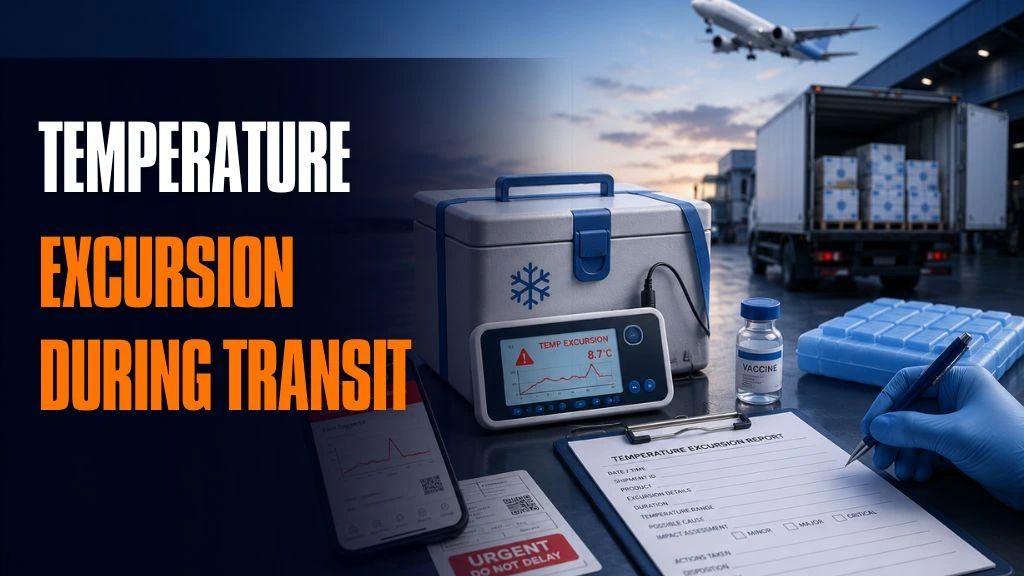
A temperature excursion during pharmaceutical transit can quickly become a quality and compliance concern. If a shipment moves outside its approved temperature range, you cannot simply assume the product is damaged—or safe. You need to establish what happened, how long the exposure lasted, which products were affected, and whether available stability data supports continued use.
For a temperature excursion pharma shipment, the immediate priority is to protect the product, preserve the temperature records, notify the appropriate quality team, and follow the company’s approved deviation procedure. WHO guidance defines a temperature excursion as exposure outside the prescribed storage or transport range, with acceptable limits determined by the product manufacturer and stability data.
Key Takeaways:
- Isolate the affected shipment and prevent unauthorised release.
- Preserve the complete temperature record from the data logger.
- Record the excursion’s duration, range, and shipment circumstances.
- Assess product impact using approved stability information.
- Document the investigation, decision, and corrective actions.
What Is a Temperature Excursion in Pharmaceutical Shipping?
A temperature excursion occurs when a pharmaceutical product is exposed to temperatures outside the range specified for its storage or transport conditions. The acceptable range is not necessarily the same for every medicine; it depends on the manufacturer’s labelled requirements and supporting stability data.
For example, WHO’s recommended descriptive storage limits include 15–25°C for controlled room temperature and 5 ± 3°C for refrigerated storage. These are recommended limits, not universal acceptance criteria for every product. The product label, manufacturer requirements and applicable regulatory framework must determine the conditions that apply to a particular shipment.
An excursion can occur during airport handling, road transport, customs clearance, temporary storage, loading or unloading. Customs-related holds are also a potential risk, as explained in our guide to pharma cold chain customs delays. It can also result from a packaging failure, incorrect conditioning of refrigerants, equipment malfunction or an unexpected delay.
That is why responding to an excursion requires more than looking at the maximum temperature recorded.
What Should You Do First After Detecting an Excursion?
When a temperature excursion pharma shipment is identified, the first response should focus on containment and evidence preservation rather than immediately deciding whether the product is usable.
1. Place the Shipment on Hold
Prevent the affected product from being released, distributed or used until the appropriate quality assessment is completed.
Clearly identify the shipment as being under investigation and follow the organisation’s approved quarantine or hold procedure.
2. Preserve the Temperature Data
Do not reset, overwrite or discard the monitoring device before its data has been captured and securely retained.
Download the complete record from the data logger, including the relevant period before, during and after the excursion where available. WHO identifies temperature monitoring as an integral part of appropriate pharmaceutical storage and recommends suitable temperature-monitoring systems for controlled environments.
3. Notify the Responsible Quality Team
Escalate the deviation according to the company’s quality management system. Depending on the shipment and organisation, this may involve quality assurance, the responsible pharmacist or qualified personnel, the manufacturer, consignee and logistics provider.
Do not allow a logistics team to make an independent product-disposition decision unless its responsibilities specifically permit this.
How to Assess the Severity of the Excursion
Not every excursion has the same impact. The assessment should establish the actual temperature exposure and compare it with product-specific evidence.
Record at least:
- Required transport temperature range
- Actual minimum temperature
- Actual maximum temperature
- Date and time of the excursion
- Duration outside the specified range
- Location or transport stage where it occurred
- Product and batch details
- Packaging configuration
- Data logger identification
- Relevant shipment events
The duration matters because a brief deviation and prolonged exposure may have very different implications for product quality.
WHO guidance states that product stability data should demonstrate the acceptable excursion time during transport for time- and temperature-sensitive pharmaceutical products.
This means a generic statement such as “the temperature went above the limit” is not enough to determine product disposition.
Why Product-Specific Stability Data Matters
The most important question after an excursion is: “Does the available stability evidence demonstrate that the product remains suitable after this specific exposure?”
The answer should come from approved product information, stability data, manufacturer guidance, or another authorised quality assessment process, rather than assumptions based on the product’s appearance or the fact that the excursion was short.
For example, a refrigerated product may have a labelled storage requirement, but that does not automatically mean every brief exposure outside that range makes the product unusable. Conversely, a seemingly small deviation may still require investigation if the product is particularly temperature-sensitive.
This is why every investigation should be product-specific, evidence-based, and properly documented.
How to Document a Temperature Excursion
Good temperature excursion documentation should allow someone reviewing the incident later to understand what happened without relying on verbal explanations.
A useful deviation record should include five core areas.
1. Shipment Information
Record:
- Shipment reference
- Product name
- Batch or lot number
- Quantity affected
- Origin and destination
- Transport mode
- Dispatch and arrival details
2. Temperature Information
Capture:
- Required temperature range
- Actual temperature range
- Excursion start and end time
- Total duration
- Maximum and minimum readings
- Data logger identification
- Downloaded temperature file or report
3. Event Information
Describe what happened and where.
For instance, the investigation may identify a delay during airport handling, an equipment fault, unexpected customs storage or a packaging issue. The record should distinguish between confirmed facts and assumptions.
4. Impact Assessment
Document:
- Product-specific stability information reviewed
- Quality assessment performed
- People involved in the assessment
- Supporting evidence
- Final disposition decision
5. Corrective and Preventive Actions
If the investigation identifies a process failure, document the action taken to prevent recurrence.
This could include reviewing packaging configuration, retraining personnel, revising handling instructions, changing monitoring arrangements or investigating the transport provider’s process.
What Should a Data Logger Shipment Record Contain?
A data logger shipment record provides objective evidence of the temperature conditions experienced during transport.
The record should be retained with the relevant shipment or deviation documentation and should be traceable to the specific consignment.
Depending on the monitoring system, useful information can include:
- Logger serial number or unique ID
- Start and stop times
- Measurement interval
- Temperature readings
- Alarm or excursion markers
- Date and time settings
- Download date
- Associated shipment reference
Do not rely only on a screenshot of the highest reading. Preserve the complete available dataset or validated report so the investigator can understand the temperature profile across the shipment.
WHO’s current temperature-mapping tool supports several recognised data logger types, illustrating the role of electronic temperature records in controlled pharmaceutical environments.
How Temperature Controlled Packaging Can Help
Temperature Controlled Packaging is designed to maintain specified temperature conditions during transport despite variations in the surrounding environment.
Depending on the shipment, packaging may use passive thermal protection or active temperature-control systems. The appropriate solution depends on factors such as product temperature requirements, transit duration, route conditions and shipment characteristics.
However, packaging should not be treated as a substitute for monitoring.
Even a qualified packaging system can encounter unexpected conditions. A shipment may face extended delays, incorrect handling, extreme ambient conditions or other events outside the original transport assumptions.
That is why packaging selection, qualification, monitoring and documented response procedures need to work together.
If you’re deciding between packaging approaches, our guide to Active vs Passive Cold Chain Packaging can help explain the operational differences and considerations involved.
How to Investigate the Root Cause
Once the product is contained and the temperature evidence is preserved, investigate why the excursion occurred.
Start with the transport timeline.
Ask:
- When did the temperature begin moving outside the permitted range?
- Where was the shipment at that time?
- Was the shipment in transit or temporarily stored?
- Was the packaging assembled according to the approved configuration?
- Were refrigerants or thermal components prepared correctly?
- Did the shipment experience an unexpected delay?
- Was the monitoring device positioned correctly?
- Did a carrier or handling facility report an operational issue?
The objective is not to assign blame immediately. It is to establish the sequence of events and determine whether the existing process worked as intended.
A root-cause investigation may reveal a packaging issue, handling error, equipment failure, route disruption, incorrect instructions or inadequate contingency planning. Knowing how to choose a freight forwarder with relevant cold-chain and air cargo experience can help reduce operational risks before shipment.
Follow a Defined Cold Chain Deviation Protocol
A documented cold chain deviation protocol provides a consistent process for responding to temperature events.
The protocol should define:
- Detection — How an excursion is identified.
- Containment — How the affected product is placed on hold.
- Notification — Who must be informed and when.
- Data collection — Which records must be preserved.
- Assessment — Who evaluates potential product impact.
- Decision — Who can approve release, rejection or another disposition.
- Investigation — How the root cause is established.
- CAPA — How recurring risks are addressed.
- Record retention — How the complete investigation is maintained.
A written procedure is particularly important when multiple parties are involved in an international shipment. The logistics provider may identify the excursion, while the manufacturer or quality team may be responsible for assessing the product.
The EU’s GDP guidance emphasises quality and integrity throughout the distribution chain, while WHO guidance similarly treats storage and distribution as activities where products can face risks requiring appropriate controls.
What Not to Do After a Temperature Excursion
Several shortcuts can make an investigation harder and create compliance concerns.
1. Do Not Automatically Reject the Product
An excursion does not by itself establish that a product has been damaged. Product-specific stability information and an authorised quality assessment should determine disposition.
2. Do Not Automatically Release It
The opposite assumption is equally risky. A shipment should not be released simply because the excursion appears minor.
3. Do Not Alter the Data
Never manipulate temperature records to make the shipment appear compliant. Preserve the original monitoring data and maintain appropriate data integrity.
4. Do Not Ignore the Packaging History
The temperature record should be assessed alongside packaging configuration, shipment duration and handling events.
5. Do Not Close the Deviation Without a Reason
A completed investigation should explain what happened, what evidence was reviewed, what decision was made and whether corrective action is necessary.
How to Prevent Future Temperature Excursions
The strongest response to an excursion is reducing the likelihood of another one.
Start by reviewing the entire transport lane rather than focusing only on the incident itself. WHO recommends profiling and qualifying transport routes and selecting suitable transport equipment and shipping containers based on anticipated environmental conditions and appropriate testing.
Your preventive review can include:
- Packaging qualification
- Route assessment
- Seasonal temperature considerations
- Transit-time planning
- Data logger placement
- Carrier handling procedures
- Contingency arrangements
- Customs and airport handling plans
- Staff training
- Temperature alarm management
Following GDP compliance for pharma exports principles can help integrate temperature control, documentation and deviation management into routine logistics processes.
Temperature Excursion Documentation Checklist
Before closing an excursion investigation, confirm that the file contains:
| Documentation item | What it should establish or capture |
| Shipment and product identification | Product name, shipment reference, quantity, and relevant identifiers |
| Batch or lot information | Exact batch or lot affected by the excursion |
| Required temperature range | Labelled or approved storage and transport conditions |
| Complete data logger record | Full temperature history for the relevant shipment period |
| Excursion start and end times | Precise point at which the temperature moved outside the approved range and when it returned |
| Minimum and maximum temperatures | Lowest and highest temperatures recorded during the excursion |
| Duration of exposure | Total time the product remained outside the approved range |
| Transport timeline | Key handling, transit, storage, loading, unloading, and delivery events |
| Packaging configuration | Packaging type, insulation, coolant, configuration, and any relevant changes |
| Manufacturer or stability information | Available evidence on product stability under the specific exposure conditions |
| Quality assessment | Documented evaluation of potential impact on product quality, safety, and suitability |
| Final product disposition | Decision to release, quarantine, return, reject, or otherwise handle the affected product |
| Root-cause investigation | Determination of how and why the temperature excursion occurred |
| Corrective or preventive action | Actions required to address the cause and reduce the risk of recurrence |
| Approval and closure record | Review, approval, supporting rationale, and formal closure of the investigation |
This checklist is a practical documentation aid, not a substitute for the product owner’s approved quality procedure or applicable regulatory requirements.
Protect Your Pharmaceutical Shipments Beyond the Temperature Reading
A temperature excursion is a controlled quality event that requires evidence, assessment, and documented decision-making. The temperature reading is only the starting point.
By isolating the affected shipment, preserving the data logger shipment record, establishing the duration and severity of the exposure, reviewing product-specific stability information, and following a defined cold chain deviation protocol, you can make the investigation more structured and defensible.
The broader objective is not simply to respond to one deviation. It is to understand why it happened and strengthen the transport process so the same failure is less likely to happen again.
If you are exporting temperature-sensitive pharmaceuticals, Clearfast Group can help coordinate the logistics and documentation processes required to support controlled international movement.
Planning your next pharma shipment? Speak with our team before dispatch to review your cold chain requirements, monitoring approach, and documentation process.
Frequently Asked Questions
1. What should I do if a pharmaceutical shipment has a temperature excursion?
Place the affected shipment on hold, preserve the complete temperature-monitoring record, and notify the responsible quality team. Document the excursion’s duration and temperature range, then assess the product against applicable manufacturer stability data and approved procedures before deciding its disposition.
2. How is a temperature excursion documented?
Temperature excursion documentation should record the shipment details, required temperature range, actual readings, excursion duration, data logger information, transport events, product-specific assessment, final disposition, and any root-cause or corrective action taken.
3. Does every temperature excursion mean the pharmaceutical product is damaged?
No. An excursion does not automatically establish product damage. The impact depends on the product, the temperature exposure, its duration, and available stability evidence. The appropriate quality function should make the final disposition decision based on approved information.
4. Why is a data logger important in pharmaceutical shipping?
A data logger provides objective evidence of the temperature conditions recorded during transport. Maintaining the complete data logger shipment record helps establish when an excursion occurred, its duration, and the temperatures reached, supporting the subsequent quality investigation.
5. How can temperature-controlled packaging reduce excursion risk?
Temperature-controlled packaging helps maintain the required conditions during transport by providing thermal protection or active temperature control, depending on the system used. Its suitability should be evaluated against the product requirements, route, expected transit duration, and environmental conditions. WHO recommends selecting suitable transport equipment and containers based on route and environmental considerations.