
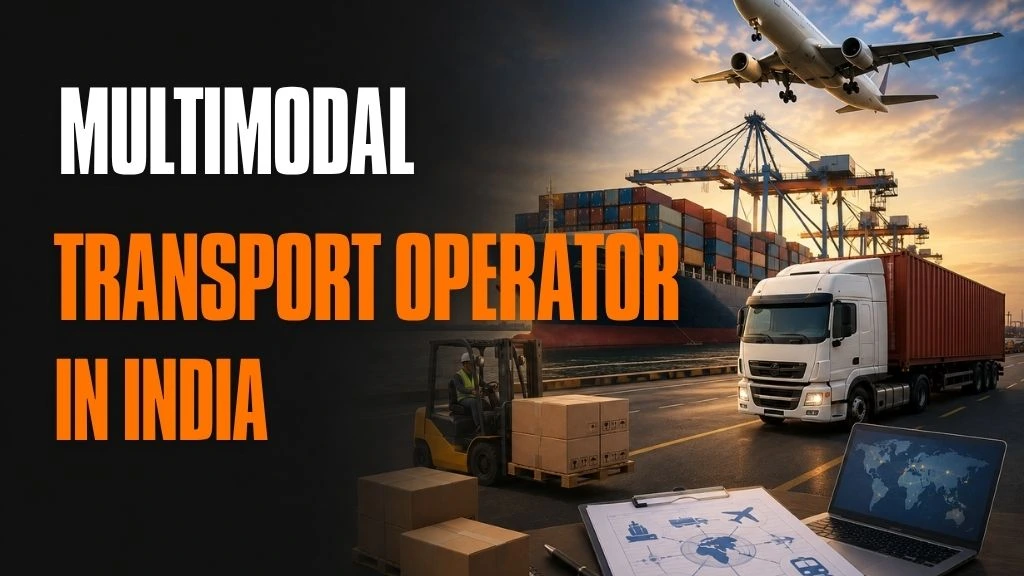
When your shipment needs a truck at origin, a vessel for the international leg, an aircraft for urgent cargo, and another truck at destination, coordinating separate providers can quickly become difficult. Different bookings, documents, handovers, and points of contact create more opportunities for delays or communication gaps.
A multimodal transport operator in India can coordinate two or more modes of transport under a single multimodal transport arrangement. Under India’s Multimodal Transportation of Goods Act, 1993, multimodal transportation for international trade involves two or more modes of transport under a single multimodal transport contract, and operators must be registered under the applicable framework.
Instead of managing sea, air, and road legs separately, you can work with one provider that coordinates the movement from origin to destination.
Key Takeaways:
- One provider can coordinate multiple transport modes under a single multimodal arrangement.
- Multimodal transport can simplify communication, documentation and shipment coordination.
- Sea freight suits cost-sensitive cargo, while air freight can address urgent delivery requirements.
- Road transport connects factories, warehouses, ports and airports to the wider freight network.
- Check the provider’s MTO registration, air-freight capabilities and customs expertise before choosing.
What Is Multimodal Transport?
Multimodal transport means moving goods using two or more different modes of transportation as part of one coordinated international movement. In India, the regulatory framework recognises multimodal transport as movement involving at least two modes under a single multimodal transport contract.
The modes can include road, rail, sea and air. For example, a shipment could travel by truck from a manufacturing facility to a port, by sea to an overseas gateway, and by road from that destination port to the final consignee.
The important point is not simply that several modes are used. Businesses should also compare door-to-door vs port-to-port freight options when deciding how much of the transportation journey should be managed under one coordinated arrangement. The value of an MTO lies in coordinating those modes as part of an integrated transport arrangement rather than leaving you to manage every carrier independently.
This distinction matters when a shipment has a tight delivery window, multiple handovers or complicated customs requirements.
How Does a Multimodal Transport Operator in India Work?
A multimodal transport operator in India acts as the party responsible for arranging the movement across multiple transport modes within the multimodal transport framework.
The Directorate General of Shipping’s guidance explains that registered MTOs can issue a Multimodal Transport Document (MTD) for qualifying export movements. The document contains key information about the goods, consignor, consignee, places of taking charge and delivery, and other terms of the multimodal movement.
In practical terms, the process can look like this:
Factory → Road transport → Port → Sea freight → Destination port → Road transport → Final delivery
If part of the shipment requires urgent movement, an air leg may be incorporated:
Supplier → Road → Airport → Air freight → Destination airport → Road → Consignee
The operator coordinates the relevant carriers, schedules and documentation so that the shipment moves from one stage to the next without requiring you to independently manage every transport contract.
The Government of India’s Directorate General of Maritime Administration currently maintains a list of valid registered MTOs, making registration an important verification point when evaluating a provider.
Why Use One Provider for Sea, Air, and Road?
The main advantage of a sea, air road single provider model is coordination.
When several providers are involved, you may have to communicate separately with a trucking company, shipping line, airline, customs broker and destination delivery agent. If one schedule changes, the impact can extend to the next transport leg.
A single multimodal provider can coordinate these interfaces.
1. One Point of Coordination
You have one primary logistics partner for the overall movement rather than managing every transport mode independently.
This can make it easier to track:
- Pickup arrangements
- Port or airport handovers
- Freight bookings
- Customs documentation
- Transit milestones
- Final delivery
It does not remove the need for specialist carriers or local partners. Instead, it gives you a central party responsible for coordinating the overall movement.
2. Better Visibility Across Transport Legs
A shipment can appear to be moving smoothly when viewed one leg at a time but still face a problem at the connection between modes.
For example, a delayed road pickup can cause a missed vessel cut-off. A vessel delay can affect the availability of a destination truck. A customs hold at an airport can make an urgent air shipment miss its planned delivery window. Similar issues can arise at major seaports, so businesses moving cargo through JNPT should understand a customs examination at JNPT for import shipments and plan accordingly.
Multimodal planning considers these connections rather than treating each leg as an isolated movement.
3. Simplified Documentation
The Indian MTO framework provides for a Multimodal Transport Document, which can serve as the contractual document for multimodal transportation. The Directorate General of Shipping notes that the MTD contains prescribed particulars and establishes the contractual framework between relevant parties.
However, this does not mean that every document associated with individual transport modes disappears. Customs, airline, shipping-line, security and destination requirements can still apply.
That is why you should ask exactly which documents the operator will issue, coordinate and review before shipment.
When Should You Choose Multimodal Freight Forwarding?
Multimodal Freight Forwarding can be particularly useful when your cargo requires different transport modes for different stages of its journey.
Consider it when:
1. Your Origin or Destination Is Away from a Port
Most international cargo does not begin at a seaport or end directly at one. Road transport is often required to connect the factory or warehouse with the relevant gateway.
A multimodal arrangement can combine the inland and international legs into one coordinated movement.
2. You Have Different Transit Priorities
Sea freight can be appropriate when cost and capacity are more important than speed. Air freight may be more suitable when delivery urgency justifies the higher transport cost.
A multimodal provider can help assess where each mode makes operational sense rather than forcing the entire shipment into one transport method.
3. Your Cargo Has Multiple Delivery Requirements
Some projects involve several consignments moving to the same destination at different times. A multimodal operator can coordinate the transport plan around the delivery schedule rather than arranging each shipment as an unrelated movement.
Sea vs Air: Which Mode Should You Use?
Choosing between sea and air is not simply a question of which option is cheaper or faster.
Sea freight is generally considered for cargo where transit time can accommodate ocean schedules and where shipment economics favour maritime transport. Air freight is typically considered when speed, time sensitivity or cargo characteristics justify the higher cost.
Your decision should consider:
- Cargo volume
- Weight
- Delivery deadline
- Origin and destination
- Cargo value
- Handling requirements
- Customs considerations
- Available services
- Total landed logistics cost
Before selecting an ocean service, businesses can also review LCL vs FCL shipping for international cargo to determine which container option suits their shipment volume.
For urgent shipments, air freight may provide a faster alternative for the relevant leg rather than requiring the entire supply chain to operate by air.
How Air & Sea Cargo Consolidation Fits Into Multimodal Transport
Air & Sea Cargo Consolidation involves grouping compatible shipments to make transport more efficient. The specific consolidation approach depends on the cargo, route, service availability and commercial requirements.
A multimodal provider may coordinate consolidated cargo with road transport at origin and destination, creating a broader door-to-door movement.
For example:
Road pickup → Consolidation facility → Sea freight → Destination handling → Road delivery
Or, for a time-sensitive portion:
Road pickup → Air cargo terminal → Air freight → Destination airport → Road delivery
The key is to evaluate the shipment as a complete logistics chain rather than selecting consolidation solely on the basis of the lowest freight rate.
What Should You Check Before Choosing an MTO?
Not every company offering “multimodal logistics” should automatically be treated as a registered MTO under India’s regulatory framework.
Before appointing a provider, verify its credentials.
1. Check MTO Registration
The Government maintains a list of valid MTO registrations. Check the operator’s registration details against the current official list rather than relying solely on a sales presentation or website claim.
2. Check Air Cargo Capability
If your shipment includes an air leg, determine whether the provider has appropriate air-freight capabilities and relevant industry relationships. Choosing an IATA-accredited agency can also provide added confidence when coordinating air-cargo movements and related documentation.
IATA’s Cargo Agency Programme provides accreditation for eligible air cargo agencies and is designed to support interaction between accredited agents and airlines. IATA also publishes country-specific accreditation requirements, including requirements applicable to India.
Our guide on How to Choose a Freight Forwarder with IATA Access can help you understand what to look for when evaluating an air-freight partner.
3. Ask Who Handles Customs
Customs clearance can affect the entire transport schedule. Ask whether customs coordination is handled internally, through a dedicated customs team, or through an appointed broker.
The provider should also explain which party is responsible for preparing and submitting the required documentation.
4. Understand Liability and Documentation
Ask for the applicable multimodal transport terms and understand the role of the Multimodal Transport Document.
India’s MMTG Act includes provisions covering the responsibilities and liabilities of the MTO, including provisions relating to loss, damage, and delay.
You should know who is responsible at each stage before the cargo moves.
What Documents Are Typically Involved?
A multimodal shipment can involve documentation from several transport stages. The exact requirements depend on the cargo, origin, destination, transport modes and applicable regulations. Understanding Incoterms 2020 for Indian traders can help clarify transportation, insurance, customs, and delivery responsibilities across the different stages of a multimodal shipment.
Common documents may include:
Export and commercial documentation
- Commercial invoice
- Packing list
- Export documentation
- Customs declarations
Transport and routing documentation
5. Shipping instructions
6. Transport documents
7. Multimodal Transport Document, when issued under the applicable framework
Mode-specific and supporting documentation
8. Air Waybill for air cargo
9. Ocean transport documentation for sea cargo
10. Insurance documentation, where applicable
The MTO framework specifically sets out requirements concerning the Multimodal Transport Document, including particulars relating to the goods, consignor, consignee, taking charge, and delivery.
Your freight forwarder should identify which documents apply to your particular shipment before cargo handover.
What Are the Risks of Using Multiple Providers Instead?
Using separate providers is not automatically wrong. In some situations, it may make commercial or operational sense.
The challenge arises when no party has clear responsibility for coordinating the complete journey.
Potential issues include:
- Conflicting schedules
- Repeated documentation requests
- Unclear responsibility during delays
- Separate tracking systems
- Handover communication gaps
- Difficulty identifying where a delay occurred
A single MTO can reduce these coordination points by taking responsibility for the multimodal movement within the agreed contractual structure.
However, you should still review the operator’s network, capabilities, service terms and experience with your cargo type before making a decision.
When Multimodal Transport May Not Be the Right Choice
Multimodal transport is not automatically the right solution for every shipment.
You may prefer separate arrangements when:
- You already have strong direct relationships with individual carriers.
- A shipment requires highly specialised handling by a particular provider.
- The route is simple and involves only one primary transport mode.
- You have an internal logistics team capable of managing multiple contracts.
- A specific carrier provides a commercially or operationally preferable direct service.
The objective is not to use as many transport modes as possible. It is to select the combination that meets your delivery, compliance, cost and handling requirements.
Final Thoughts
A multimodal transport operator in India can simplify international cargo movement by coordinating road, sea and air services as part of one broader transport arrangement. The biggest benefit is not simply having access to multiple modes; it is having one party coordinate the connections between them.
For exporters and importers, that can mean fewer coordination points, clearer accountability and a more structured approach to documentation and transport planning.
Before choosing a provider, verify MTO registration, assess its air and sea capabilities, understand its customs process, and review the contractual responsibilities attached to the multimodal movement. With our presence since 1997, ClearFast brings extensive experience in supporting businesses with freight forwarding, customs and international logistics.
If you need Freight Forwarding support involving sea, air and road transport, speak with the ClearFast Group team, an IATA-accredited agency, to understand the complete route, documentation and responsibility at every handover.
Frequently Asked Questions
1. What is a multimodal transport operator in India?
A multimodal transport operator in India is a registered operator that arranges international movement using two or more modes of transport under a multimodal transport framework. India’s MMTG Act, 1993, regulates this activity and provides for multimodal transport documentation.
2. Can one provider handle sea, air, and road freight?
Yes. A multimodal logistics provider can coordinate road, sea, and air legs within an overall transport arrangement, depending on the route, cargo, and service requirements. The exact combination should be determined based on delivery time, cargo characteristics, and regulatory requirements.
3. What is the difference between multimodal transport and multimodal freight forwarding?
Multimodal transport refers to the movement of goods using two or more transport modes under the applicable multimodal transport framework. Multimodal freight forwarding is a broader commercial logistics activity that may involve arranging and coordinating multiple modes and service providers.
4. Why should I check MTO registration in India?
MTO registration is important because India’s MMTG Act regulates the business of multimodal transportation, and the competent authority maintains registered operators. The current government list can be used to verify an operator’s registration status.
5. Does IATA accreditation matter for a multimodal shipment involving air freight?
It can be relevant when the provider is handling an air-cargo leg. IATA’s Cargo Agency Programme provides accreditation and related services for eligible cargo agencies, while India has specific accreditation requirements published by IATA.