
A wrong HS code can turn a routine customs clearance into a documentation problem. If the classification declared for your goods does not match the product’s actual characteristics or the applicable tariff provisions, customs authorities may seek clarification, reassess the goods, or examine supporting documents before clearance.
HS code classification in India is based on the tariff structure under India’s Customs Tariff framework, which incorporates the internationally harmonised system of classifying goods. The World Customs Organization (WCO) describes the Harmonized System as a structured nomenclature in which goods are identified through headings and subheadings, with the international HS code generally extending to six digits. India then uses its national tariff structure beyond that level.
That distinction matters because a classification decision is not simply about finding a code that sounds similar to the product. You need to assess the product’s nature, function, composition, technical characteristics, and the applicable Section, Chapter, and Subheading Notes and General Rules for Interpretation.
Key Takeaways:
- Use the product’s actual characteristics, not a generic description, to determine its HS classification.
- Check the applicable tariff heading, notes, and interpretation rules before filing customs documents.
- An incorrect code can affect duty, restrictions, exemptions, and other customs requirements.
- Keep the HS code consistent across invoices, declarations and supporting documents.
- Review complex classifications with qualified customs brokerage professionals before filing.
What Is HS Code Classification in India?
The Harmonized System is an international product nomenclature developed by the WCO. It contains thousands of commodity groups, each identified internationally by a six-digit code and arranged within a legal and logical structure. More than 200 countries and economies use the HS as a basis for their customs tariffs and trade statistics.
India applies the international HS structure through its national tariff. Indian customs tariff entries can extend to eight-digit tariff items, which means an importer cannot always stop at identifying the correct international six-digit subheading. The specific Indian tariff item must also be checked against the applicable tariff schedule and current notifications. CBIC notifications, for example, routinely identify goods by eight-digit tariff items when specifying applicable customs treatment.
The classification process therefore involves more than searching an online code database. The WCO’s classification framework includes the General Rules for Interpretation, Section and Chapter Notes, Subheading Notes, and Explanatory Notes. The WCO also maintains classification opinions for products where interpretation may require greater technical clarity.
For Indian imports, the Department of Revenue’s Customs Tariff Unit is specifically responsible for matters including classification of imported and exported goods, interpretation of tariff provisions, and the issue of tariff advice and instructions.
How HS Code Errors in India Trigger Customs Delays
The immediate problem with an incorrect classification is not always the code itself. The bigger issue is the chain of customs consequences that can follow from that declaration.
1. The Declared Description May Not Support the Code
Your commercial invoice might describe an item as a “machine part”, while the technical specification identifies it as a specialised component designed solely for a particular machine.
That difference can matter during harmonized system code classification because classification depends on the applicable tariff language and interpretative rules, rather than on whichever product description appears easiest to use.
If customs finds that the description and classification do not align, officers may require additional technical information or supporting documentation.
2. The Applicable Duty Treatment Can Change
Tariff classification can determine which rate or customs measure applies to imported goods. Indian customs notifications regularly specify particular tariff items when prescribing exemptions, anti-dumping duties or other customs treatment.
This means an incorrect classification can result in an incorrect duty calculation or an incorrectly claimed exemption. Accurate classification is also important when learning how to calculate landed cost for imported goods, as customs duty can form a significant part of the overall import cost.
The issue is not limited to paying too much or too little duty. A classification error may also require reassessment and supporting clarification before the shipment can be released.
3. Additional Regulatory Requirements May Be Missed
Some tariff items can be connected with specific regulatory conditions, restrictions or documentation requirements.
If you select a code based only on a broad product name, you may overlook requirements attached to the correct tariff item.
That creates a compliance risk as well as a potential delay.
The Most Common HS Code Classification Mistakes
HS code classification errors often start with simple shortcuts, but they can lead to incorrect duty assessments, additional scrutiny and avoidable customs clearance delays.
1. Using the Supplier’s Code Without Verification
A foreign supplier may provide an HS code on its commercial invoice. That code can be useful as a starting point, but you should not automatically assume it is the correct Indian tariff classification.
Different countries can have different national tariff subdivisions beyond the international six-digit HS level. India applies its own tariff structure, so the Indian tariff item needs to be verified independently.
2. Choosing a Code Based Only on the Product Name
Product names are often too broad for accurate classification.
Consider the difference between:
- Industrial pump
- Pump component
- Hydraulic pump
- Electric pump
- Replacement part
These descriptions may refer to related products but do not necessarily lead to the same tariff treatment.
The classification should be supported by the actual technical characteristics and the relevant tariff provisions.
3. Ignoring Section and Chapter Notes
The heading that appears to describe a product most closely is not necessarily the correct classification.
The WCO’s General Rules for Interpretation work alongside Section, Chapter, and Subheading Notes to establish how goods should be classified. The Explanatory Notes provide the official international interpretation of the HS.
Ignoring these rules can lead to a classification that appears reasonable at first glance but does not withstand customs scrutiny.
4. Confusing a Part With a Complete Machine
Machinery imports frequently contain components, accessories, and replacement parts. Treating every item associated with a machine as though it should carry the machine’s classification can create an error.
The classification of parts can depend on the tariff structure and the applicable notes. The WCO Trade Tools, for example, contain specific provisions addressing the classification of machine parts under relevant headings.
This is why technical specifications should be available when classifying specialised machinery and components.
5. Reusing an Old HS Code Without Checking Current Rules
Tariff schedules and customs measures can change. The WCO periodically updates the international HS, while India’s tariff and customs notifications can also change the treatment applicable to particular tariff items. The WCO notes that HS updates take place periodically, generally every five to six years.
An old classification should therefore be reviewed rather than copied into a new shipment without verification.
What Information Do You Need for Accurate Classification?
A classification review becomes much easier when the customs team receives enough technical information from the beginning.
Prepare documents and information such as:
- Exact commercial product name
- Product description
- Manufacturer and model
- Intended use
- Principal function
- Material or composition
- Technical specifications
- Operating principle
- Product catalogue
- Technical drawings, where relevant
- Photographs, where useful
- Whether the item is a complete machine, part or accessory
- Country of origin
- Previous classification decisions, if applicable
For technical products, a short generic description is rarely enough. The person reviewing the classification needs to understand what the goods actually are and what they do.
The WCO’s classification resources specifically provide access to the HS Nomenclature, Explanatory Notes, and Classification Opinions to support classification analysis.
How to Prevent a Tariff Classification Customs Delay
A proactive classification process helps you catch HS code discrepancies early, maintain consistent customs documentation, and reduce the risk of delays during import clearance.
1. Build Classification Into the Import Process
Do not treat HS classification as the final administrative step before filing.
Make it part of your shipment planning process:
Product identification → Technical review → HS classification → Indian tariff verification → Document consistency check → Customs filing
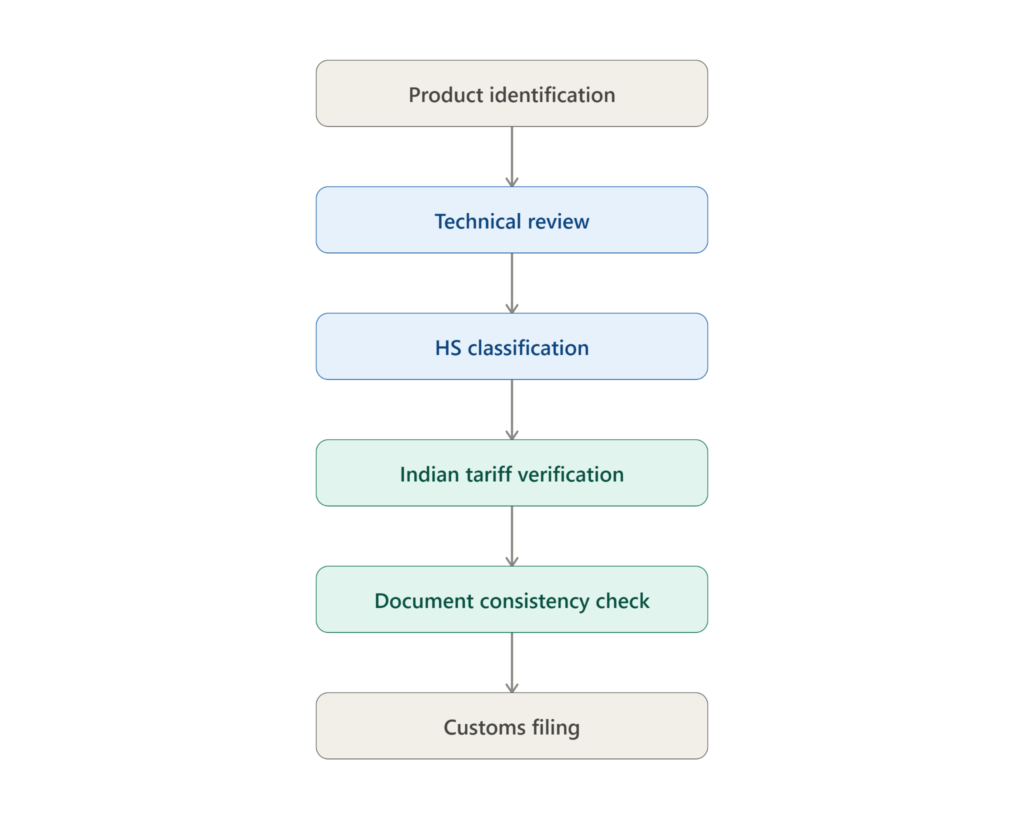
This approach gives your team time to investigate questions before the cargo reaches the port.
2. Cross-Check Every Customs Document
Once the classification has been established, check that the same information is reflected consistently across the relevant documents.
Review:
- Commercial invoice
- Packing list
- Bill of Entry information
- Product description
- Quantity and units
- Country of origin
- Declared value
- HS code
A classification may be correct but still create questions if the accompanying description is vague or contradictory. For import documentation, it is also useful to understand the Bill of Entry vs Bill of Lading explained in our guide to avoid confusion between customs and transport documents.
3. Keep Supporting Evidence Ready
If your product is technically complex, retain the documents used to support the classification decision.
For example, a machinery classification file could contain the manufacturer’s catalogue, technical datasheet, product drawings and explanation of the equipment’s principal function.
This gives your customs team a documented basis for the declared classification rather than relying on a generic product description.
4. Use Customs Brokerage for Complex Goods
Professional customs brokerage can be particularly useful where classification involves specialised machinery, multiple components, technical products or tariff provisions that require detailed interpretation. Working with an IATA-accredited agency also gives businesses access to experienced logistics and documentation support alongside customs expertise.
A broker can review the available information, identify classification concerns and coordinate customs documentation. However, the importer should still provide accurate product information and review the classification basis rather than treating the code as a number supplied without explanation.
What Happens When Customs Questions Your Classification?
A customs query does not necessarily mean the goods have been permanently stopped. If your shipment is routed through JNPT, understanding a customs examination at JNPT for import shipments can help you prepare for additional inspection or document requests. It means the declared information may need further examination or clarification before the assessment or clearance process can proceed.
The response should be evidence-based.
Start by checking:
- What product was actually imported?
- What characteristics support the declared classification?
- Which tariff heading and subheading were considered?
- Which Section or Chapter Notes apply?
- Are the supporting technical documents consistent?
- Does the Indian tariff item match the current tariff schedule?
- Are there relevant customs notifications or classification opinions?
The WCO identifies its Explanatory Notes as the official international interpretation of the HS and provides Classification Opinions for specific products. These resources can be useful when a classification question requires more than a basic keyword search.
For Indian customs matters, the Department of Revenue’s Customs Tariff Unit is responsible for classification-related matters and tariff advice, reinforcing that classification is a formal customs function rather than simply an internal accounting decision.
A Practical HS Code Classification Checklist
Product and technical review
1. The product description accurately identifies the goods.
2. The product’s principal function has been established.
3. Technical specifications have been reviewed.
Tariff and rules verification
4. The relevant Section and Chapter have been considered.
5. The applicable General Rules for Interpretation have been followed.
6. Relevant Section, Chapter, and Subheading Notes have been checked.
7. The international six-digit HS classification has been verified.
8. The corresponding Indian tariff item has been checked.
9. Current Indian customs notifications have been reviewed where relevant.
Documentation and final review
10. The declared code is consistent across customs documents.
11. Supporting technical documents are available.
12. Complex classifications have been reviewed with appropriate customs expertise.
This process does not eliminate every possibility of a customs query, but it gives you a defensible and documented basis for the classification you declare.
How HS Classification Fits Into the Wider Customs Clearance Process
HS classification is only one part of customs compliance. A correct code cannot compensate for incorrect valuation, missing permits, inconsistent invoices, or incomplete supporting documentation.
That is why classification should be reviewed alongside the wider clearance process. You can also review these customs clearance mistakes causing delays at seaports to identify other issues that may hold up your shipment.
A coordinated approach is especially important when multiple parties are involved. Your supplier, freight forwarder, customs broker, and internal procurement or finance teams should work from consistent product and shipment information.
Final Thoughts
HS code classification in India is not simply a matter of finding the closest product description in a tariff search. It requires you to understand the goods, apply the relevant classification rules, and verify the applicable Indian tariff item.
The most common HS code errors in India often begin with seemingly small shortcuts: copying a supplier’s code, relying on a generic product name, overlooking tariff notes or using an outdated classification. Those shortcuts can create questions over duty, documentation and regulatory treatment, potentially turning a planned clearance into a delayed one.
A stronger approach is to classify the goods before filing, document the reasoning, verify the current tariff position, and keep supporting technical information ready. For complex imports, involving experienced customs brokerage support early can help identify classification concerns before they become clearance problems.
Established in 1997, Clearfast team can help review your upcoming import and export requirements and plan the customs clearance process before your shipment arrives.
Frequently Asked Questions
1. What is HS code classification in India?
HS code classification in India is the process of assigning imported or exported goods to the appropriate tariff heading, subheading, and applicable Indian tariff item under the Customs Tariff framework. The classification is based on the characteristics of the goods and the applicable interpretation rules.
2. What are common HS code errors in India?
Common errors include using a supplier’s foreign classification without verification, selecting a code based only on the product name, confusing machinery parts with complete machines, overlooking tariff notes, and relying on outdated classifications.
3. Can an incorrect HS code cause a customs delay?
Yes. A classification discrepancy can lead customs authorities to seek clarification, supporting technical information, or reassessment. The resulting review can delay the clearance process, particularly when the declared classification affects duty or other customs requirements.
4. How can I verify an HS code for an imported product?
Start with the product’s technical characteristics and identify the relevant heading using the HS classification rules, Section and Chapter Notes, and supporting WCO classification resources. Then verify the corresponding Indian tariff item and applicable current customs provisions before filing.
5. When should I involve a Customs Brokerage provider?
Consider involving a customs brokerage provider before filing when the product is technically complex, has multiple components, falls into potentially competing tariff headings, or has specific regulatory or duty implications. An early review can give you time to resolve classification issues before customs clearance.