
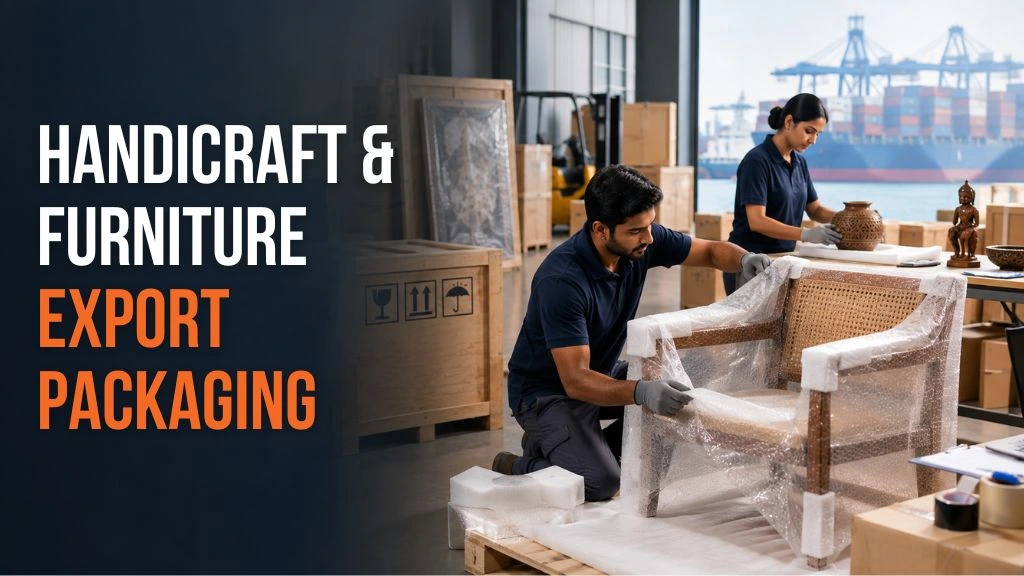
A damaged carved panel, scratched wooden chair, or broken decorative piece can turn a carefully prepared export order into a costly claims process. For handicraft and furniture exporters, packaging has to protect the product through handling and transport while also meeting the requirements that apply to the packaging material itself.
For exporters using wooden pallets, crates, or dunnage, wood packaging compliance under ISPM-15 is a separate consideration. The International Plant Protection Convention (IPPC) developed ISPM-15 to address the risk of quarantine pests associated with raw-wood packaging moving in international trade.
Key Takeaways:
- Use packaging that protects fragile surfaces, joints and decorative components from handling damage.
- Check whether wooden pallets, crates or dunnage used with an export shipment fall within ISPM-15 requirements.
- Keep product descriptions, values, quantities and package details consistent across export documents.
- Confirm destination-country requirements before dispatch because import controls can differ.
- Assess oversized furniture early if standard containers or handling arrangements may not be suitable.
Why Export Packaging Needs More Than a Protective Box
Handicrafts & Furniture products rarely have uniform shapes. A carved wooden cabinet, for example, may have projecting handles, glass panels, delicate finishes or irregular dimensions. A metal-and-wood handicraft may also combine surfaces that react differently to impact, moisture or abrasion.
Furniture presents a different challenge. Larger pieces may be heavy, difficult to manoeuvre and vulnerable to damage at contact points during loading and unloading.
That makes packaging part of the logistics plan rather than an afterthought.
The objective is not simply to add more material around the product. Packaging should be appropriate to the item’s construction, dimensions, surface finish, handling conditions and transport route.
For an exporter, this means considering the journey from the workshop or warehouse through inland transport, terminal handling and international carriage before deciding how the item should be protected.
The commercial terms should also be reviewed alongside Incoterms 2020 and export packaging responsibilities, particularly where different parties handle transport stages.
A well-planned package can also make cargo identification easier during handling. Clear package marks and consistent shipment information help link physical cargo with its commercial and transport documents.
Before your next shipment leaves the warehouse, review the complete journey rather than only the packaging at the point of dispatch.
How to Reduce Damage in Handicraft Shipping India
The first step in handicraft shipping India is understanding what is actually vulnerable.
A fragile decorative surface may need protection from abrasion, while a large wooden item may need protection around corners, legs or other projecting parts. Glass, mirrors and other breakable components require different considerations from solid wooden structures.
1. Protect the Vulnerable Parts First
Do not treat every part of an item as equally exposed.
Identify surfaces and components that could be affected by:
- Impact
- Scratching
- Compression
- Vibration
- Movement inside the package
- Contact with other cargo
The packaging design can then focus protection where the product is most vulnerable.
This is particularly relevant for handcrafted goods because their value may depend on surface finish, carving, texture or decorative detail. A small visible mark can have a much greater commercial impact than it would on an ordinary industrial product.
2. Prevent Movement Inside the Package
A package can appear secure externally while the product moves internally during handling.
Internal supports should therefore be considered alongside the outer packaging. The aim is to reduce unnecessary movement without placing damaging pressure on delicate components.
For furniture, particular attention should be paid to projecting sections and structural points that may experience pressure when the package is moved.
3. Separate Fragile Surfaces From Hard Contact Points
Finished wood, glass, polished metal and painted surfaces can be vulnerable when they come into direct contact with harder materials.
Protective separation between vulnerable surfaces and packaging components can reduce the chance of scratches, dents or finish damage.
The precise packaging method should depend on the product and transport conditions rather than following a single formula for every export.
ISPM-15: Why Wood Packaging Compliance Matters
If your export shipment uses wooden packaging, one of the most important compliance questions is whether the wood packaging material falls within ISPM-15.
ISPM-15 is titled “Regulation of wood packaging material in international trade.” The standard addresses phytosanitary risks associated with wood packaging made from raw wood and covers material such as dunnage. It excludes wood packaging made from processed wood in ways that make it free from pests, with plywood given as an example by the IPPC.
The purpose is not to regulate the Handicrafts & Furniture product itself. It addresses the potential movement of quarantine pests through wood packaging material used in international trade.
That distinction is important.
A furniture exporter may have a fully compliant product but still face an issue if the wooden packaging supporting or protecting that product does not satisfy the applicable requirements of the destination country.
The IPPC notes that ISPM-15 provides a harmonised approach for countries to manage pest risks associated with wood packaging material.
What Counts as Wood Packaging Material?
The IPPC describes wood packaging material as wood or wood products, excluding paper products, used to support, protect or carry a commodity. Its implementation resources include dunnage within the scope of wood packaging material.
For exporters, that means the compliance review should not stop at the main crate.
Consider all wooden packaging and support material used with the shipment, including pallets, crates and relevant dunnage.
The exact treatment, marking and import controls applicable to a shipment should be verified against the current requirements of the destination country and the relevant phytosanitary authorities.
What Does an ISPM-15 Mark Tell You?
An ISPM-15 mark is associated with compliant wood packaging material.
The IPPC explains that the recognised mark may be applied to wood packaging material treated in accordance with the standard. The organisation also maintains implementation resources covering treatment, marking, manufacturing, repair, reuse and responses to non-compliance.
For an exporter, the practical lesson is straightforward: do not assume that any wooden crate or pallet is automatically suitable for international export.
The packaging supplier and relevant compliance parties should be able to establish that the material meets the applicable requirements.
This matters because non-compliant wood packaging can become a phytosanitary issue even when the underlying shipment contains no plant products.
India’s Directorate of Plant Protection, Quarantine & Storage has also reported stakeholder discussions concerning ISPM-15 compliance and non-compliance notifications involving wood packaging material and dunnage exported from India.
If your shipment uses wooden packaging, confirm compliance before the cargo is packed and dispatched—not after it reaches the destination.
Furniture Export Documentation: What Should You Check?
Packaging and documentation need to tell the same story.
India’s export framework identifies the Bill of Lading/Airway Bill/Lorry Receipt/Railway Receipt, Commercial Invoice cum Packing List, and Shipping Bill/Bill of Export among the mandatory export documents. Additional documents may apply depending on the goods, restrictions, policy conditions or product-specific requirements.
For Handicrafts & Furniture shipments, the commercial and logistics documentation should accurately reflect the physical cargo.
Depending on the shipment, review information such as:
- Exporter and consignee details
- Product description
- Quantity
- Package count
- Value
- Applicable classification
- Gross and net weight
- Dimensions where relevant
- Transport details
- Country of origin where required
- Any additional destination-specific documentation
The objective is consistency.
If the invoice describes one number of packages while the physical shipment contains another, or the packing list does not correspond with the cargo presented for export, clarification may be required.
ICEGATE confirms that additional documents can apply depending on the commodity, notification claimed and participating government agency requirements.
Do Not Treat Every Destination the Same
There is no universal furniture export documentation package that automatically covers every destination.
Import-country requirements can depend on the product, materials used, packaging, applicable trade measures and local regulations.
This is particularly important for wooden products because requirements relating to wood packaging material are connected to phytosanitary controls and may be implemented differently by individual countries.
Before shipment, verify the destination’s current import requirements rather than relying on documentation from an earlier shipment to another market.
Packaging and Documentation Must Match
One practical way to reduce avoidable questions is to compare the physical cargo against the documentation before dispatch.
Check whether:
- The number of packages matches the packing list.
- Product descriptions are consistent.
- Dimensions are recorded accurately where required.
- Weight information is consistent.
- Shipping marks correspond with the packages.
- Wooden packaging compliance has been checked where applicable.
- Any additional certificates or approvals required for the destination have been identified.
This pre-dispatch review is particularly useful for SMEs where the same person may be coordinating production, packaging and export documentation.
Indian Customs uses electronic systems for export documentation, and ICEGATE provides facilities connected with Shipping Bills and supporting documentation.
Correct information at the start reduces the need for amendments later. Understanding what happens during the customs clearance process can help exporters identify documentation issues before cargo reaches the clearance stage.
What About Fragile Handicrafts With High-Value Finishes?
High-value handicrafts need a packaging approach that considers the product’s commercial and aesthetic characteristics.
For example, a decorative item with a hand-finished surface may be more sensitive to abrasion than a plain structural component. Similarly, a piece with glass, ceramic or other fragile elements may require separate protection within the overall package.
Exporters should also consider how the item will be handled after leaving the workshop. Packaging that works for careful warehouse handling may not provide the same protection through repeated loading and unloading.
The answer is not necessarily heavier packaging. It is appropriate packaging based on the actual product and transport journey.
Document the condition of finished goods before packing and retain relevant packaging and shipment records. This creates a clearer record if a damage claim or transport query later arises.
When Does Furniture Need Special Handling?
Most furniture can move through standard freight channels when its dimensions, weight, packaging and handling requirements fit the selected transport service.
The situation changes when an item is unusually large, heavy or difficult to handle.
Oversized furniture may affect:
- Vehicle selection
- Warehouse handling
- Container utilisation
- Port or terminal handling
- Lifting arrangements
- Route planning
- Shipment costs
- Delivery access at destination
This should be assessed before the cargo is manufactured or packed for export.
For furniture that fits standard cargo arrangements, choosing between LCL and FCL for furniture exports may also form part of the shipment planning process.
A large dining table, exhibition structure or architectural furniture piece may have dimensions that make a standard container arrangement impractical. In such cases, exporters may need to explore specialised transport or project cargo options.
For oversized furniture shipments, the Project, ODC & Break-Bulk service can be used as the relevant internal resource.
Do you have furniture that may exceed standard transport dimensions? Confirm its packed dimensions and weight early so the transport plan can be assessed before dispatch.
A Practical Pre-Shipment Review for Exporters
Before handing a handicraft or furniture shipment to the logistics provider, run a final review. Exporters should also consider choosing a freight forwarder for international exports based on the transport mode and coordination requirements of the shipment.
1. Product and Packaging
- Confirm the product is adequately protected against foreseeable handling risks.
- Check that vulnerable surfaces and components have suitable protection.
- Confirm the package is stable and the cargo cannot move unnecessarily.
- Verify package dimensions and weight.
- Inspect the finished package before handover.
2. Wood Packaging Compliance
- Identify whether pallets, crates or dunnage contain regulated wood packaging material.
- Check the current destination-country requirements.
- Confirm applicable ISPM-15 compliance with the relevant packaging supplier or responsible party.
- Retain supporting records where appropriate.
- Do not assume a previous shipment’s packaging arrangement is automatically acceptable for a new destination.
3. Export Documentation
- Compare the commercial invoice with the actual cargo.
- Check the packing list against the physical packages.
- Verify the Shipping Bill/export documentation requirements.
- Confirm whether destination-specific documents are required.
- Check that package marks and documentation are consistent.
This review does not replace advice from the relevant customs or phytosanitary authorities. It is a practical control point before cargo enters the export process.
The Cost of Getting Packaging or Documentation Wrong
Damage is the most obvious risk, but it is not the only one.
Poor packaging can result in:
- Product damage
- Customer claims
- Rework or replacement costs
- Delivery disruption
- Additional handling
Documentation or phytosanitary non-compliance can create a different set of problems, including inspection, queries or destination-country action.
These risks can also overlap with customs clearance mistakes that can delay shipments, particularly when documentation and cargo details do not match.
The IPPC’s ISPM-15 implementation resources specifically address import inspection procedures and phytosanitary actions in response to non-compliance.
For an SME exporter, these problems can be particularly disruptive because one delayed shipment may affect production planning, customer commitments and cash flow at the same time.
That is why packaging and compliance should be reviewed together before dispatch.
Final Thoughts
Successful handicraft export packaging in India is about more than protecting a product from bumps during transport. Exporters also need to consider the packaging material itself, particularly when wooden pallets, crates or dunnage are used.
ISPM-15 provides the international phytosanitary framework for managing pest risks associated with regulated wood packaging material. At the same time, accurate export documentation helps ensure that the shipment presented to Customs matches the commercial and physical details declared for it.
For furniture and handicraft exporters, the safest approach is to review packaging, dimensions, documentation and destination requirements before the shipment leaves the warehouse.
Frequently Asked Questions
What is ISPM-15 and why does it apply to wood packaging in furniture exports?
ISPM-15 is an international phytosanitary standard for regulating wood packaging material used in international trade. It addresses the risk of pests being moved through raw-wood packaging such as pallets, crates and dunnage. Furniture exporters using regulated wooden packaging should verify the destination country’s requirements before shipment.
How can handicraft exporters reduce in-transit damage claims?
Handicraft exporters can reduce damage risks by designing packaging around the product’s vulnerable surfaces and components. Protect finished surfaces from abrasion, prevent unnecessary movement inside the package, and provide appropriate support for fragile parts. Pre-shipment photographs and condition records can also provide useful evidence if damage is reported.
What customs documentation is specific to handicraft and furniture exports?
There is no single customs document that applies exclusively to every handicraft or furniture export. Common export documents include the commercial invoice cum packing list, Shipping Bill and transport document, while additional documents may apply depending on the product, destination, applicable regulations and trade requirements.
Does furniture that exceeds standard container dimensions need special handling?
Furniture exceeding normal transport dimensions may require specialised logistics planning. Oversized pieces can affect container selection, vehicle requirements, lifting arrangements, route planning and terminal handling. Exporters should confirm packed dimensions and weight early so the appropriate transport method and any applicable ODC or project-cargo arrangements can be assessed.