
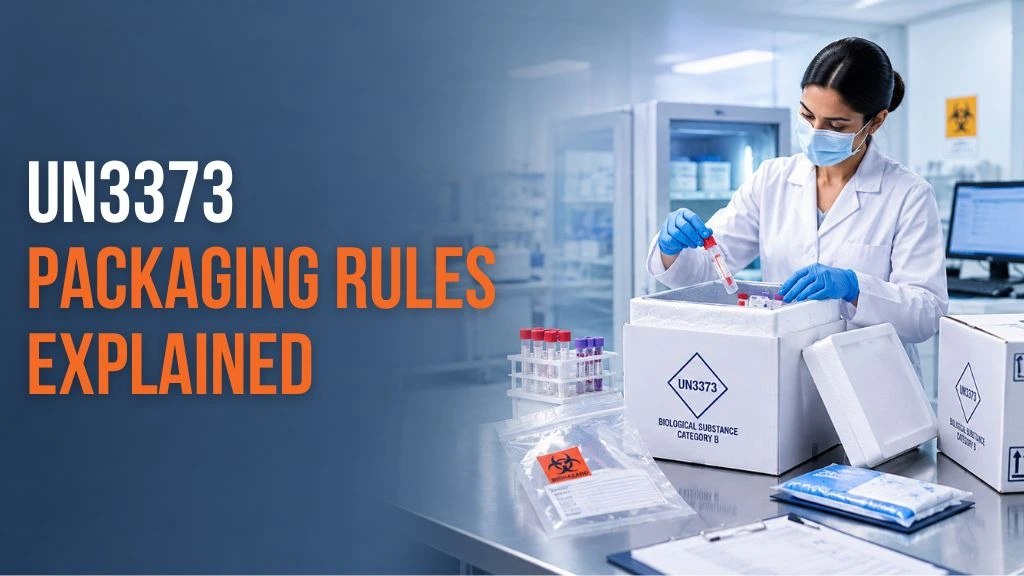
When a diagnostic sample is held because its classification is unclear or its packaging does not meet the applicable transport rules, the problem is bigger than a delayed parcel. A specimen can miss a testing window, disrupt a clinical workflow, or require additional compliance review before it can move.
For UN3373 biological sample shipping, the starting point is classification. UN3373 applies to infectious substances that meet the criteria for Category B rather than Category A. For air transport, these shipments are prepared under IATA Packing Instruction 650 (PI 650), which requires a triple packaging system comprising a primary receptacle, secondary packaging and outer packaging.
Key Takeaways:
- UN3373 identifies Biological Substance, Category B under the applicable dangerous-goods framework.
- Classification must be completed before choosing the packaging or transport documentation.
- Category A and Category B are distinguished by the potential consequences of exposure.
- IATA PI 650 requires three packaging components for UN3373 air shipments.
- Dry ice introduces additional dangerous-goods considerations that must be assessed separately.
What Is UN3373?
UN3373 is the United Nations identification number assigned to Biological Substance, Category B. Category B covers infectious substances that do not meet the criteria for Category A. WHO’s transport guidance and laboratory biosafety materials distinguish Category B from Category A based on the severity of disease that could result from exposure.
This classification is important because the UN number determines the regulatory framework that applies to the shipment. A laboratory should therefore avoid treating every human specimen as automatically being UN3373.
A specimen may instead fall into another category, including Category A or an applicable exemption, depending on its contents and the circumstances of the shipment. WHO’s current 2025–2026 guidance emphasises classification as a core part of the transport process and notes that requirements can differ by transport mode and applicable national or international rules.
For a QA or logistics team, the practical question is not simply, “Is this a human specimen?” It is: What is the correct transport classification for this specific material?
Category A vs Category B: Why the Distinction Matters
The Category A/Category B distinction is based on risk, not simply on whether a specimen comes from a patient.
1. Category A
A Category A infectious substance is one that, when transported in a form capable of exposure, can cause permanent disability, life-threatening disease or fatal disease in otherwise healthy humans or animals. For substances affecting humans, the relevant UN number is UN 2814; substances affecting animals only may be assigned UN 2900.
Category A shipments are subject to the more stringent requirements associated with their applicable packing instruction and dangerous-goods transport framework.
2. Category B
A Category B infectious substance does not meet the criteria for Category A. Such infectious substances are generally assigned UN3373, Biological Substance, Category B.
The distinction cannot safely be made by assuming that a commonly transported diagnostic sample is always Category B. Classification should consider the biological agent, the form in which it is transported, the source material and relevant professional risk assessment.
WHO guidance also notes that new or emerging pathogens may require careful professional assessment where they do not appear in indicative lists.
For QA teams, classification should therefore be documented as part of the shipment decision rather than treated as a packaging choice made at the end.
What Does IATA PI 650 Require?
For air transport, IATA PI 650 packaging applies to UN3373 shipments. IATA’s current 67th Edition Packing Instruction 650 specifies the packaging, marking and documentation requirements applicable to UN3373.
The packaging consists of three principal components:
- Primary receptacle
- Secondary packaging
- Outer packaging
At least one of the secondary or outer packaging components must be rigid under the applicable requirements. PI 650 also sets specific performance requirements for UN3373 packaging. For liquid specimens, the primary receptacle or secondary packaging must be capable of withstanding an internal pressure producing a pressure differential of at least 95 kPa without leakage. For solid specimens, the outer packaging must not contain more than 4 kg, except for packages containing body parts, organs or whole bodies; this limit excludes ice, dry ice or liquid nitrogen used to keep specimens cold.
The completed package must also be constructed to withstand the shocks, loadings, vibration and changes in temperature, humidity and pressure normally encountered during transport. DHL’s UN3373 guidance specifies that the rigid outer packaging should be capable of passing a 1.2-metre drop test without leakage. These performance requirements are important because triple packaging alone does not demonstrate that a package can withstand transport conditions.
This is commonly described as a triple packaging system.
The purpose is straightforward: containment should remain effective if the shipment experiences the normal physical stresses associated with transportation, including handling and movement between transport facilities. Similar principles of controlled handling and documented transport planning are important when reviewing vaccine and biologics cold chain shipping requirements. WHO’s current guidance similarly identifies triple packaging as a fundamental packaging approach for infectious substances.
1. Primary Receptacle
The primary receptacle is the container that directly holds the specimen. For liquid specimens, it must be leakproof and must not contain more than 1 L under IATA PI 650. The primary receptacle or the secondary packaging must also be capable of withstanding an internal pressure producing a pressure differential of at least 95 kPa without leakage.
For solid specimens, the primary receptacle must be siftproof and must remain within the applicable weight limits of the packaging. If several fragile primary receptacles are placed inside one secondary package, they must be individually wrapped or separated to prevent them from coming into contact with one another.
The primary receptacle should therefore be assessed as part of the complete packaging system rather than as an isolated container.
2. Secondary Packaging
The secondary packaging provides another layer of containment around the primary receptacle.
Under PI 650, primary receptacles must be packed so that they cannot break, be punctured or leak their contents into the secondary packaging under normal transport conditions. Suitable absorbent material is required where applicable for liquid contents.
Where multiple primary receptacles are placed inside a secondary package, the configuration must prevent them from damaging one another.
3. Outer Packaging
The outer packaging provides the external protective layer and carries the required transport marks.
For UN3373 air shipments, the outer package must display the prescribed UN3373 diamond-shaped mark and the proper shipping name, BIOLOGICAL SUBSTANCE, CATEGORY B, in accordance with the applicable requirements. IATA PI 650 also specifies information that must be provided for the shipper and consignee.
The outer package is therefore more than a shipping box. Its construction, marking and relationship with the inner packaging are all part of the compliance framework.
Packaging Is Only One Part of Compliance
A compliant-looking package does not automatically make a shipment compliant.
Before dispatch, the logistics and QA teams should have clarity on:
- Classification
- Applicable transport mode
- Packaging instruction
- Package markings
- Required documentation
- Shipper and consignee information
- Carrier requirements
- Import or export requirements
- Any additional dangerous goods present
WHO’s 2025–2026 guidance specifically covers classification, packaging, marking, labelling and documentation and stresses that infectious-substance transport requirements need to be considered across applicable transport modes and regulatory frameworks.
This matters particularly for human specimen shipping in India where a shipment may involve domestic movement before an international air leg. Requirements applicable to the domestic portion and the international air transport portion should not be assumed to be identical. For temperature-sensitive biological materials, exporters should also consider pharma cold chain customs delays and temperature risks when planning the complete shipment route.
For regulated biological substances, DG Packaging & Logistics may form part of the broader compliance planning process alongside classification, packaging and documentation. The specific requirements depend on the substance, transport mode and applicable regulations.
Does UN3373 Require a Dangerous Goods Declaration?
Not necessarily. This is an area where shipment teams often apply rules from Category A to Category B without checking the applicable requirements.
For UN3373 packages prepared and marked according to IATA PI 650, IATA specifies a limited set of requirements, including shipper and consignee information and responsible-person contact information. Where an Air Waybill is used, IATA PI 650 requires the Nature and Quantity of Goods box to show UN 3373, BIOLOGICAL SUBSTANCE, CATEGORY B, and the number of packages, subject to the stated exception.
This differs from Category A shipments, for which dangerous-goods transport documentation requirements are more extensive. WHO’s laboratory biosafety guidance identifies a dangerous-goods declaration among the documentation requirements for Category A, while listing a different documentation framework for Category B.
The exact documentation package can still depend on the transport mode, carrier, route and national requirements.
The safe approach is to verify the current modal rules and carrier acceptance requirements for each shipment rather than assuming that “UN3373 means no dangerous-goods paperwork.”
What Changes When Dry Ice Is Used?
Dry ice is a separate compliance consideration.
Dry ice is assigned UN1845 and is classified as a Class 9 dangerous good for air transport. WHO’s current guidance notes that the ICAO Technical Instructions contain a specific packing instruction, PI954, for shipments containing dry ice by air.
This means that a UN3373 shipment packed with dry ice has two relevant considerations:
The biological substance: UN3373 and its applicable packaging requirements.
The coolant: UN1845 dry ice and its applicable requirements.
When temperature-sensitive specimens require dry ice or another controlled-temperature solution, Temperature Controlled Packaging & Logistics becomes an important part of the overall shipment plan. The packaging must still meet the applicable biological-substance requirements, while the coolant and transport conditions need to be assessed separately.
The dry ice must also be able to release carbon dioxide gas as it sublimates. WHO explains that packaging containing dry ice must allow adequate gas release because the build-up of carbon dioxide can create a pressure and safety hazard.
The documentation requirements for dry ice also need to be assessed. IATA’s current Dangerous Goods Regulations include specific provisions for situations where a Shipper’s Declaration is not required, including information concerning UN1845 on the Air Waybill or alternative transport documentation where applicable.
Dry ice should therefore never be treated as simply a temperature-control accessory. It can introduce a separate dangerous-goods compliance layer.
What About Exempt Human Specimens?
Not every human specimen is automatically an infectious substance.
WHO distinguishes exempt human specimens from Category A and Category B infectious substances. Exempt specimens are those for which there is a minimal likelihood that infectious agents are present, and they are subject to fewer dangerous-goods requirements. However, WHO still describes a triple-layer packaging approach for exempt specimens to provide adequate containment.
This distinction is useful for laboratories because it prevents two opposite errors:
- Treating every patient specimen as dangerous goods
- Assuming a low-risk specimen requires no special containment
The classification decision should be based on the applicable transport framework and the characteristics of the specimen—not simply on the fact that it originated from a human.
Common Compliance Mistakes in Biological Sample Shipping
Small documentation or classification errors can delay biological sample shipments. Knowing the correct classification, packaging and transport requirements helps your QA team avoid preventable compliance issues.
1. Assuming Every Diagnostic Sample Is UN3373
A diagnostic sample may be Category B, Category A or potentially an exempt specimen depending on its characteristics. Classification must come before packaging selection.
2. Using a Generic Triple Package
“Triple packaging” describes the structure, but compliance also depends on the applicable requirements for the specific classification and transport mode.
3. Treating Dry Ice as Ordinary Refrigerant
Dry ice is UN1845 for air transport and brings additional requirements. It should be assessed separately from the biological substance.
4. Using Outdated Regulatory Information
Dangerous-goods rules are updated. WHO’s current 2025–2026 guidance applies from 1 October 2025, while ICAO’s 2025–2026 Technical Instructions apply through 31 December 2026.
QA teams should therefore verify the edition applicable to the shipment date rather than relying on an old internal checklist.
5. Treating Packaging as the Entire Compliance Process
Packaging is only one part of the process. Classification, documentation, markings, carrier acceptance and applicable national requirements all need to align.
A Practical Pre-Dispatch Review for UN3373 Shipments
Before releasing a shipment, the responsible QA or logistics team can verify the following at a high level:
| Check | Question |
| Classification | Has the specimen been correctly classified? |
| UN number | Does the assigned UN number match the classification? |
| Packaging | Does the packaging meet the applicable packing instruction? |
| Triple packaging | Are the primary, secondary and outer components correctly configured? |
| Marking | Are the required UN3373 marks and shipping-name information present? |
| Documentation | Are the required transport documents prepared? |
| Dry ice | If used, has UN1845 been assessed separately? |
| Carrier | Has the carrier’s current acceptance requirement been confirmed? |
| Route | Have origin, transit and destination requirements been checked? |
| Records | Can the classification and shipment decisions be demonstrated if reviewed? |
This checklist is not a substitute for the applicable IATA Dangerous Goods Regulations, ICAO Technical Instructions or national requirements. It is a QA review framework to help identify issues before handover.
What This Means for Diagnostic Labs, CROs and Pharma Manufacturers
For a laboratory or pharmaceutical organisation, the strongest compliance process is one where classification is decided before the shipment reaches the packing stage.
That means the QA and logistics functions should have a defined process for determining:
What is the material? → What category does it fall into? → Which transport rules apply? → Which packaging instruction applies? → What markings and documents are required?
For international shipments, this decision chain becomes particularly important because the cargo may move through several parties, including the laboratory, packaging provider, freight forwarder, airline, customs authorities and receiving organisation.
The WHO’s current guidance is intended for laboratories, logistics providers, public health institutions and regulatory authorities and specifically addresses classification, packaging, marking, labelling and documentation.
For organisations regularly shipping clinical and diagnostic materials, documented classification decisions and current regulatory references can make internal audits and shipment reviews easier to manage. These documented processes can also support broader GDP compliance requirements for pharma exports where applicable to the organisation and shipment.
Conclusion
UN3373 biological sample shipping is fundamentally a classification and compliance issue, not simply a packaging exercise.
For Category B infectious substances, IATA PI 650 provides the relevant air-transport packaging framework, including the primary receptacle, secondary packaging and outer packaging. Category A materials follow a different classification and compliance pathway, while exempt human specimens may fall outside many dangerous-goods requirements.
Dry ice adds another layer because it is itself regulated as UN1845 for air transport.
For diagnostic laboratories, CROs and pharma manufacturers, the most reliable approach is to classify the specimen first, verify the current modal requirements, use packaging appropriate to that classification, and confirm documentation before the shipment is handed to the carrier.
Where specialist packaging or logistics support is required, check our Human Specimens & Biological Samples industry resources, Temperature Controlled Packaging & Logistics, and DG Packaging & Logistics service information for the relevant shipment requirements.
Send ClearFast your shipment details today to discuss the applicable UN3373 classification, packaging and documentation requirements before dispatch. Get your compliance questions addressed early and plan the next step with greater clarity.
Frequently Asked Questions
What is UN3373 and which shipments does it apply to?
UN3373 applies to infectious substances classified as Biological Substance, Category B. It is used when the substance does not meet the criteria for Category A. Air shipments of UN3373 are subject to IATA Packing Instruction 650 (PI 650).
What’s the difference between Category A and Category B biological substances?
Category A substances can cause permanent disability, life-threatening disease or fatal disease following exposure, while Category B substances do not meet those criteria. Category A human infectious substances use UN2814, while Category B substances use UN3373.
Does shipping human specimens require dangerous goods documentation?
It depends on how the specimen is classified and which transport mode is used. UN3373 shipments have different documentation requirements from Category A shipments, while dry ice can introduce additional requirements. Always verify the current IATA and carrier requirements.
What packaging is required under IATA PI 650?
IATA PI 650 requires a triple packaging system: a primary receptacle, secondary packaging and outer packaging. The packaging must provide appropriate containment and protection, with required UN3373 markings and other applicable information on the outer package.