
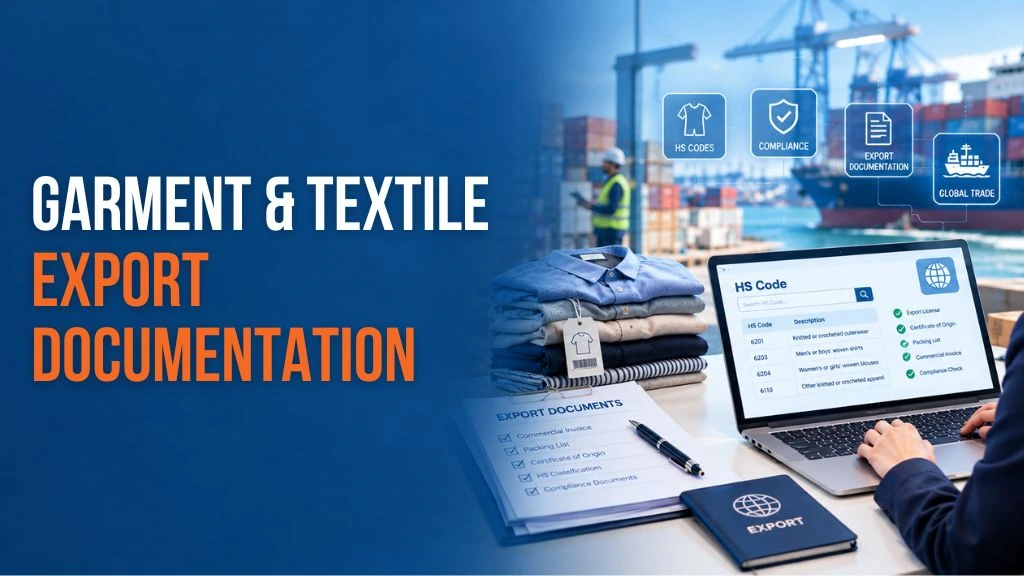
Home Furnishing & Garments exporters often face documentation issues when product details, fabric composition, or HS codes are not accurately reflected in their export paperwork. For a manufacturer scaling exports, correcting documentation at that stage can mean queries, rework, and avoidable delays.
Getting garment export documentation requirements for India right starts with correctly identifying the product. The HS classification depends on factors such as whether an apparel item is knitted or crocheted, what it is made from, and what type of garment it is. India’s tariff structure places knitted or crocheted apparel in Chapter 61 and non-knitted/non-crocheted apparel in Chapter 62, while other made-up textile articles fall under Chapter 63.
Key Takeaways:
- Classify garments by construction, garment type, and applicable textile composition rules.
- Chapter 61 covers knitted or crocheted apparel; Chapter 62 covers non-knitted or non-crocheted apparel.
- Core export documents include the transport document, commercial invoice/packing list, and Shipping Bill.
- Check destination-country requirements separately from India’s export documentation.
- Scheme benefits such as RoSCTL or RoDTEP require exporters to check current eligibility and procedures.
Why HS Code Classification Matters for Garment Exports
An HS code is not simply a number to add to an invoice. It identifies the product for customs and trade purposes and can affect how the shipment is treated under the applicable tariff and policy framework.
For garments, classification can become more detailed than simply choosing “apparel.”
The product’s construction, garment type, and textile material can all matter. India’s tariff and trade references show separate classifications within Chapters 61 and 62, including distinctions based on garment type and textile material. DGFT’s HS-code mapping, for example, lists different classifications for dresses and jackets according to whether they are made from cotton, synthetic fibres, artificial fibres, or other textile materials.
That means a generic product description such as “women’s garment” may not provide enough information to support accurate classification.
For an export manager, the practical lesson is simple: do not select an HS code from an old invoice or a similar-looking product without checking the current tariff classification.
Chapter 61 vs Chapter 62: The First Classification Check
One of the first questions in apparel HS code classification is whether the garment is knitted or crocheted.
1. Chapter 61: Knitted or Crocheted Apparel
Chapter 61 covers articles of apparel and clothing accessories that are knitted or crocheted.
This includes various categories of garments and accessories, with further classification depending on the particular product and material.
Examples can include knitted or crocheted:
- T-shirts
- Pullovers
- Cardigans
- Certain dresses
- Other clothing accessories
The exact tariff item should still be checked against the product’s actual construction and characteristics.
2. Chapter 62: Non-Knitted or Non-Crocheted Apparel
Chapter 62 covers articles of apparel and clothing accessories that are not knitted or crocheted.
This chapter also contains multiple garment-specific classifications.
For example, DGFT’s HS code mapping includes separate entries for suits, ensembles, jackets, blazers, and dresses, with further distinctions based on textile material.
Do not treat Chapter 61 and Chapter 62 as interchangeable. The construction of the garment is an important starting point for classification.
Fabric Composition Can Change the Classification
Fabric composition is another area where textile exporters need to be careful.
A garment may contain cotton, synthetic fibres, artificial fibres, wool or another textile material. The relevant tariff structure can distinguish between these materials at more detailed levels.
DGFT’s published HS-code mapping demonstrates this within Chapter 62. For example, separate entries are shown for dresses of cotton, synthetic fibres and artificial fibres, while jackets and blazers are also differentiated by material in the relevant classifications.
This is why the product-development or merchandising team’s fabric information should match the information used for export documentation.
Before finalising an HS code, verify the product description against the actual specification, including:
- Fibre or material composition
- Knitted or woven construction
- Garment category
- Intended product description
- Applicable tariff notes
Where classification is uncertain, obtain an appropriate customs classification review rather than guessing.
This is particularly important when you have several styles that look similar but use different fabrics or constructions.
For manufacturers importing fabrics or other inputs, calculating landed costs for imported textile inputs can provide a clearer picture of the overall cost before production and export.
Garment Type Also Matters
“Apparel” is a broad commercial term, but customs classification goes deeper.
A shirt, dress, jacket, trousers, suit, ensemble, or clothing accessory may fall under different tariff items. The relevant heading can also distinguish between knitted and non-knitted products and, within some classifications, between textile materials.
For exporters managing dozens or hundreds of styles, this creates a documentation challenge.
A practical internal control is to maintain an HS classification master linked to the product or style master. The purpose is not to assume that every new style needs a new code, but to ensure that classification decisions are reviewed when the product’s material, construction or design changes.
That can help prevent a common error: carrying an old classification forward simply because the new product has a similar commercial name.
Core Garment Export Documentation Checklist
The basic export documentation framework is not unique to textiles.
DGFT’s Foreign Trade Policy identifies the mandatory documents for export of goods from India as:
- Bill of Lading/Airway Bill/Lorry Receipt/Railway Receipt/Postal Receipt, as applicable.
- Commercial Invoice cum Packing List, with separate commercial invoice and packing list also accepted.
- Shipping Bill/Bill of Export/Postal Bill of Export, as applicable.
The exact documentation package can expand when a particular product, destination, scheme or regulatory requirement calls for additional documents.
1. Commercial Invoice and Packing List
The invoice and packing information should accurately describe the exported garments.
Pay particular attention to:
- Exporter and buyer details
- Product description
- Quantity
- Value
- Currency
- Package details
- Weight
- Applicable HS classification
- Shipping terms and other relevant commercial information
Export teams should also understand Incoterms 2020 and export shipping responsibilities when reviewing the commercial terms stated in an international sales contract.
A mismatch between the invoice and the physical cargo can create avoidable questions during clearance.
2. Shipping Bill
The Shipping Bill is a customs document required for export clearance. DGFT’s export guidance states that it is filed through the Indian Customs Electronic Gateway (ICEGATE).
ICEGATE’s current filing guidance also shows that Shipping Bill information includes exporter, consignee, package, and shipment details, among other fields.
3. Transport Document
Depending on the transport mode, the relevant document may be a Bill of Lading, Airway Bill, Lorry Receipt, Railway Receipt or Postal Receipt. DGFT identifies these within the mandatory export documentation framework.
For teams handling both imports and exports, understanding Bill of Entry and Bill of Lading documents can help clarify the different roles these documents play in international trade.
4. Certificate of Origin, When Required
A Certificate of Origin establishes the origin of the goods. Whether you need one depends on the destination, buyer requirements, applicable trade agreement or other circumstances.
Do not treat a Certificate of Origin as an automatic requirement for every garment shipment. Confirm the requirement for the specific transaction.
Textile Export Compliance: What Exporters Often Miss
Having the three core export documents does not automatically mean every shipment is ready.
DGFT specifically notes that certain goods or categories subject to restrictions, policy conditions, NOCs or product-specific compliance requirements may require additional documents.
For garment exporters, check the following before dispatch.
1. Destination-Country Requirements
Indian export clearance and destination-country import clearance are separate compliance questions.
Your buyer or destination customs requirements may call for additional information concerning:
- Product composition
- Origin
- Labelling
- Consumer-product requirements
- Preferential tariff treatment
- Restricted goods or materials
These requirements vary by destination and product, so they should be confirmed before shipment rather than assumed from an earlier order.
2. Buyer-Specified Documents
A buyer may require documents beyond India’s core export documentation, such as inspection or quality-related documents.
DGFT’s export guidance notes that an importer can require quality inspection before shipment.
If a purchase contract contains documentation conditions, treat them as part of the shipment checklist.
3. Supporting Documents on ICEGATE
ICEGATE provides for electronic submission of supporting documents associated with customs declarations. Its current documentation framework includes supporting documents such as licences, certificates and permits where applicable.
The important point is to identify applicable supporting documents before filing rather than discovering a missing document after a customs query.
Scheme-Specific Documentation: RoSCTL and RoDTEP
Garment exporters may also evaluate whether an applicable export remission scheme is relevant to their products.
The current Foreign Trade Policy identifies RoSCTL the Scheme for Rebate on State and Central Taxes and Levies as a duty-remission scheme notified by the Ministry of Textiles. Exporters evaluating RoDTEP can also review how exporters can claim RoDTEP duty remission and the key procedural considerations involved.
It also identifies RoDTEP as the scheme for remission of duties and taxes on exported products, notified by the Department of Commerce and administered by the Department of Revenue.
However, exporters should not assume that every garment automatically receives a particular benefit.
Eligibility, rates, HS-code coverage and procedural requirements can change through notifications. DGFT’s 2025 notification, for example, addressed changes to RoDTEP for specified categories including Advance Authorisation holders, SEZs and EOUs and referred exporters to the applicable appendices and HS codes.
For that reason, scheme claims should be checked against the current DGFT notifications and applicable schedules at the time of export.
Common Documentation Mistakes in Garment Exports
Even when the basic export documents are in place, small classification or documentation errors can create avoidable questions during customs clearance. Here are some common mistakes garment exporters should check before dispatch. These issues overlap with customs clearance mistakes that delay export shipments, particularly when documentation is incomplete or inconsistent.
1. Copying an HS Code From an Older Shipment
A previous shipment may look similar but use a different fabric, construction or garment type.
- Better approach: review the classification whenever the product specification changes.
2. Using a Broad Product Description
“Garments” or “textiles” may not adequately describe the actual exported product.
- Better approach: use a product description that corresponds to the classification and commercial documents.
3. Ignoring Fabric Composition
The material can matter at the tariff-item level.
- Better approach: verify the composition against the product specification before classification.
4. Assuming One Code Covers Every Style
A product catalogue can contain garments with different construction and material characteristics.
- Better approach: maintain a reviewed HS-code matrix for recurring export products.
5. Treating Scheme Documentation as Automatic
A shipment may qualify for one scheme but not another, depending on current rules and product classification.
- Better approach: verify current eligibility, rates, and documentation before making a claim.
6. Checking Documentation Only at the Port
Late corrections are harder to manage when the cargo is already moving.
- Better approach: conduct a pre-shipment documentation review covering classification, invoice, packing list, Shipping Bill information, and any applicable supporting documents.
A Practical Pre-Shipment Checklist for Export Managers
Before releasing a garment shipment for export, confirm:
- Product construction has been identified correctly.
- Fabric composition matches the product specification.
- Garment type matches the selected tariff classification.
- Applicable HS code has been reviewed against the current tariff/ITC-HS information.
- Commercial invoice is complete and consistent.
- The packing list matches the physical shipment.
- Applicable Shipping Bill information is ready.
- Transport document details are available.
- Certificate of Origin has been arranged if required.
- Destination-country requirements have been checked.
- Buyer-specific documentation requirements have been confirmed.
- Applicable scheme eligibility has been checked against current rules.
- Supporting documents required for customs filing are available.
For the HS code and clearance side of the process, see the Customs Brokerage service page for information on customs clearance support.
Final Thoughts
Good garment export documentation starts before the shipment reaches customs. The critical first step is accurate product identification: knitted or crocheted construction, garment type, and textile composition can all influence classification.
Once the classification is established, the exporter can build the rest of the documentation package around the actual shipment, destination and applicable schemes. Keeping invoice, packing, Shipping Bill and supporting information consistent reduces the risk of avoidable documentation queries.
For manufacturers expanding into international markets, documentation should be treated as part of export planning not as paperwork completed after the goods are ready.
If you need support reviewing export documentation and customs requirements for a garment shipment, contact ClearFast for a shipment-specific assessment.
Frequently Asked Questions
What HS code chapters cover garments and textiles?
Garments are mainly classified under Chapter 61 for knitted or crocheted apparel and Chapter 62 for non-knitted or non-crocheted apparel. Chapter 63 covers certain other made-up textile articles.
What documents are required to export garments from India?
Key documents include the commercial invoice, packing list, Shipping Bill, and applicable transport document. Additional certificates or documents may be required depending on the product, destination, and export scheme.
What compliance mistakes commonly delay textile export shipments?
Common mistakes include incorrect HS codes, inconsistent fabric or product descriptions, mismatched invoice and packing details, missing supporting documents, and overlooked destination-country requirements.
Do garment exports require any scheme-specific documentation?
Not always. If you claim a scheme such as RoSCTL or RoDTEP, check the current DGFT rules, eligibility, HS-code coverage, and applicable documentation before filing.