
Importing capital goods under the Export Promotion Capital Goods (EPCG) Scheme is only one part of the compliance process. Once the machinery is installed and production begins, exporters must also track their export obligations, maintain supporting records and complete the formal closure process. Missing export records, unreported shortfalls or discrepancies between shipping bills and realisation details can complicate redemption even when substantial exports have taken place.
EPCG EODC refers to the Export Obligation Discharge Certificate issued after the Directorate General of Foreign Trade (DGFT) is satisfied that the applicable export obligation has been fulfilled or appropriately regularised. Under the Handbook of Procedures (HBP) 2023, exporters apply online using ANF 5B, supported by the prescribed documents.
Key Takeaways:
- Track specific and average export obligations separately.
- Reconcile shipping bills, export values and realisation records regularly.
- Apply for EODC online through ANF 5B with the prescribed evidence.
- Address export shortfalls through the applicable regularisation process.
- Verify closure requirements against your authorisation and current DGFT rules.
What Is EPCG Export Obligation?
The EPCG Scheme allows eligible exporters to import capital goods under specified customs-duty concessions, subject to the conditions of the applicable authorisation. For a broader overview, read our guide to EPCG Scheme eligibility and import conditions, including the framework governing capital goods imports and export obligations. In return, the authorisation holder must fulfil the export obligation prescribed under the scheme.
The obligation is not simply a target to check at the end of the authorisation period. It is a compliance commitment that requires regular monitoring of export performance, records and deadlines.
Under the general framework described in the DGFT’s EPCG guidance, two obligations may apply:
- Specific export obligation: Generally calculated at six times the duty saved, subject to the applicable policy provisions and the final obligation endorsed on the authorisation.
- Average export obligation: Where applicable, this requires export performance to be maintained at the prescribed average level based on the relevant preceding years.
The specific and average obligations must be assessed independently. Meeting the specific target does not automatically establish that every other condition has been satisfied.
For an exporter managing multiple authorisations, the practical challenge is maintaining a reliable record of the obligation attached to each licence, the exports counted against it and any approved amendments or extensions.
Businesses using different export incentive schemes should also understand the differences between EPCG and the Advance Authorisation Scheme, as each has its own eligibility conditions and compliance requirements.
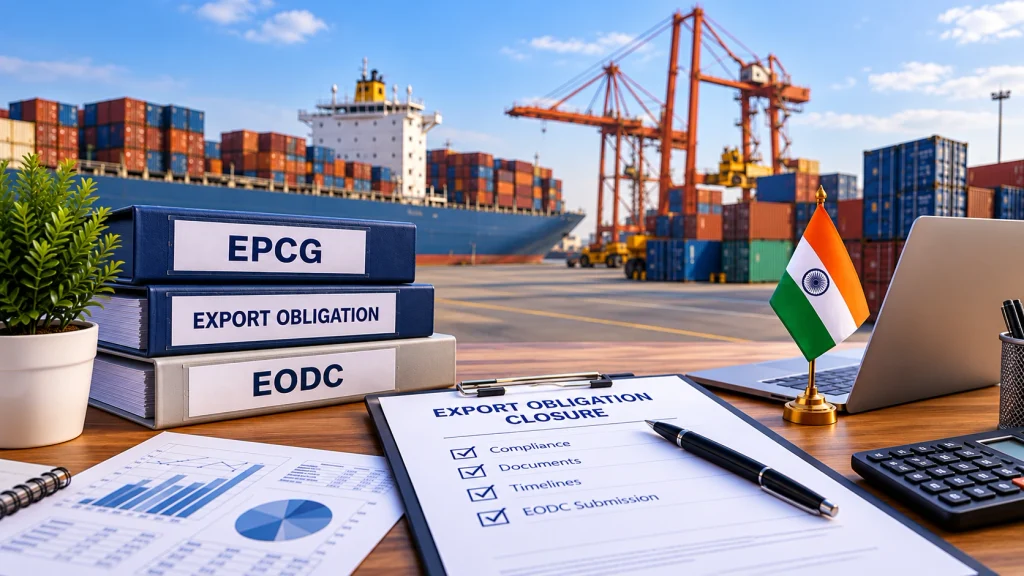
What Is EPCG EODC and Why Does It Matter?
An Export Obligation Discharge Certificate confirms that the relevant export obligation has been discharged to the satisfaction of the competent DGFT Regional Authority (RA). It is the formal closure evidence exporters need after completing the prescribed requirements.
The EODC process matters because export performance alone does not necessarily close an EPCG authorisation automatically. The exporter must submit the required application and supporting evidence, and the competent authority must review the information.
According to paragraph 5.20 of HBP 2023, the authorisation holder applies online in ANF 5B. Once satisfied, the Regional Authority issues the EODC and forwards an online copy to ICEGATE for further action by the jurisdictional Customs authorities where a bank guarantee or letter of undertaking has been executed.
This connection between DGFT and Customs makes accurate records important beyond the initial export transaction. If the export evidence does not reconcile with the authorisation or the data available to the authorities, the closure process may require clarification or correction.
How to Close an EPCG Licence: The EODC Process
The EPCG EODC process involves reconciling export performance, preparing the required evidence, submitting the closure application and responding to any deficiencies identified during assessment.
The following workflow provides a practical overview. The precise requirements depend on the authorisation, its issue date and the applicable provisions.
Step 1: Review the EPCG Authorisation
Start with the original authorisation and all approved amendments. Confirm the duty-saved amount, export products, prescribed export obligation, obligation period and any applicable block-wise requirements.
If the business has several EPCG authorisations, prepare a separate compliance record for each one. This reduces the risk of applying exports against the wrong authorisation or overlooking a deadline.
Step 2: Reconcile Export Performance
Collect the shipping bills, export invoices and other supporting records relevant to the obligation. Check that the export values, product descriptions, authorisation references and realisation details agree with the information being used for closure.
Maintaining accurate export documentation and HS code records can help teams cross-check product details and supporting paperwork during reconciliation.
Where third-party exports are involved, additional evidence may be required. HBP 2023 sets out conditions and supporting documents for exports through third parties, including shipping documents, evidence of dispatch and financial evidence of export proceeds.
Step 3: Check Whether the Obligation Is Complete
Calculate the export obligation fulfilled against the applicable requirements. Review specific and average export obligations separately, including any approved extensions, amendments or applicable relief.
Do not treat the total value of exports as sufficient proof on its own. The relevant exports must qualify under the applicable scheme provisions and be supported by the required evidence.
Step 4: Submit the Online EODC Application
The DGFT’s EPCG guidance identifies the following online route:
Services → EPCG → Closure of EPCG Authorisation (ANF 5B).
The applicant selects the authorisation and chooses the applicable closure option, such as redemption, regularisation or surrender, as permitted by the circumstances. The prescribed supporting documents must accompany the application.
Step 5: Respond to Deficiencies and Follow Through
Monitor the application and address any deficiency raised by the Regional Authority. If a shipping bill is missing from the application, DGFT guidance advises checking the shipping bills repository; non-EDI shipping bills may need their details entered in the repository.
Once the EODC is issued, check whether any further action is required with the jurisdictional Customs authority, particularly where a bank guarantee or letter of undertaking remains relevant. Understanding the customs process after export documentation is submitted can help exporters plan for any additional formalities that remain after DGFT issues the certificate.
Practical recommendation: Keep a closure tracker showing the application reference, submission date, outstanding queries, supporting documents and next action. This is an internal control, not a substitute for the prescribed DGFT procedure.
Common EPCG Compliance Mistakes That Delay Closure
Most closure difficulties are easier to address when exporters identify them before submitting ANF 5B. The following issues deserve particular attention.
1. Using Export Values Without Reconciling Supporting Records
An export summary may show that a target has been met, but the supporting records may contain discrepancies. Differences between shipping bills, invoices, export proceeds and the authorisation reference can make it harder to establish which exports qualify.
How to avoid it: Reconcile the export ledger against the shipping bills and relevant realisation records before preparing the EODC application. Keep a clear explanation and supporting evidence for any adjustments.
2. Ignoring the Average Export Obligation
Exporters sometimes concentrate on the specific obligation because it is linked to the duty saved. However, where an average export obligation applies, it must also be assessed under the relevant rules.
HBP 2023 provides for the use of excess exports in one year to offset a shortfall in another year, subject to the applicable overall average obligation and relevant period requirements.
How to avoid it: Maintain separate calculations for specific and average obligations, with annual results and supporting records.
3. Missing Block-Wise Compliance Requirements
The applicable EPCG provisions may require export obligation to be fulfilled in defined blocks. Under the general HBP 2023 framework, the specific obligation is divided between the first four years and the following two years, with the prescribed proportions applying to each block.
How to avoid it: Record the authorisation issue date, block deadlines, achievement and any extension. Check which version of the policy and procedures applies to the specific authorisation rather than assuming every licence follows identical historical conditions.
4. Leaving Annual Reporting Until Closure
Annual export obligation reporting is a separate compliance consideration. HBP 2023 paragraph 5.14 provides for online annual reporting to the concerned Regional Authority by 30 June, with a late fee specified for delayed reporting.
How to avoid it: Assign an owner to annual reporting and set reminders before the due date. Review the relevant requirement for the authorisation and applicable rules, especially where the licence was issued under an earlier policy.
5. Overlooking Third-Party Export Evidence
Exports made through a third-party exporter may count towards fulfilment where the prescribed conditions are met. However, they require more than a statement that goods were exported on the licence holder’s behalf.
DGFT’s procedures identify supporting evidence that may include the relevant shipping documents, dispatch evidence, financial evidence of realisation and the required third-party undertaking or disclaimer.
How to avoid it: Identify third-party exports early and collect the relevant documents while the transaction records are readily available.
What Happens If the EPCG Export Obligation Is Not Fulfilled?
An exporter who has not fulfilled the prescribed export obligation should not assume that the authorisation can be closed in the same way as a fully compliant licence.
HBP 2023 paragraph 5.21 provides for regularisation of a shortfall through payment of the applicable customs duty, taxes and cess in proportion to the unfulfilled obligation, together with applicable interest as prescribed by Customs. The provisions also address voluntary exit in the circumstances covered by the procedure.
The amount and procedure should not be estimated from the original duty-saved figure alone. The calculation depends on the applicable authorisation, actual utilisation, export obligation fulfilled and relevant rules.
An exporter should therefore distinguish between:
- Redemption: Seeking discharge after fulfilling the applicable export obligation.
- Regularisation: Addressing a shortfall through the applicable prescribed process.
- Surrender: Giving up an authorisation where surrender is permitted under the applicable provisions.
These options are not interchangeable. For example, the DGFT FAQ states that an authorisation against which imports have been made cannot be surrendered through the unutilised-authorisation route described in that guidance.
Exporters reviewing their wider incentive arrangements can also explore duty drawback and export incentive schemes to understand the separate provisions that may apply to eligible export transactions.
Because the financial and compliance consequences depend on the facts, exporters should verify the applicable procedure with the relevant authority and a qualified trade-compliance professional before acting.
Documents to Prepare for EPCG Licence Closure
The exact supporting documents depend on the authorisation, export route and closure option. Use the following checklist as a starting point, then confirm the prescribed requirements in the current DGFT procedure.
| Document or record | Purpose |
| EPCG authorisation and approved amendments | Establishes the applicable conditions and obligation |
| Shipping bills or bills of export | Supports evidence of qualifying exports |
| Export invoices and export statements | Helps reconcile goods, values and transactions |
| Export realisation evidence, including relevant e-BRC records | Supports verification of export proceeds where applicable |
| Annual export obligation reports | Supports review of reporting compliance |
| Third-party export documents, where relevant | Establishes the required link between the authorisation holder and exports |
| Chartered Accountant certificate in the prescribed format, where required | Supports closure documentation |
| TR-6 Challan for applicable regularisation cases | Evidences the relevant customs payment |
| Approved extension or amendment records, where applicable | Establishes the revised terms or deadlines |
DGFT’s EPCG FAQ specifically identifies a TR-6 Challan for regularisation cases and a Chartered Accountant certificate in the prescribed Appendix 5C format among the attachments required for closure. The final document list should be checked against the applicable online application and current instructions.
A Practical Document-Reconciliation Workflow
Before submission, prepare one reconciliation sheet with the following columns:
- EPCG authorisation number
- Shipping bill number and date
- Export value and currency
- Exporter or third-party exporter details
- Export realisation reference
- Specific obligation credited
- Average obligation credited, where applicable
- Supporting document status
- Outstanding discrepancy and action owner
This format is a recommended internal control, not an official DGFT form. It helps the finance, export documentation and compliance teams work from the same records.
Current EPCG Changes: What Exporters Should Verify
EPCG authorisations can be subject to different policy provisions depending on when they were issued. The Handbook of Procedures 2023 expressly states that certain extension provisions for authorisations issued before the Foreign Trade Policy 2023 are governed by the relevant provisions applicable on the date of issue.
This makes it important to check the policy version and subsequent amendments before calculating a deadline or applying for an extension.
DGFT also issued Public Notice No. 51/2025–26 on 6 March 2026, providing a time-limited automatic extension for specified export-obligation periods expiring between 1 March and 31 May 2026, up to 31 August 2026. That published extension period has passed; exporters should not assume it applies to a current or future deadline.
For current closure work, verify the latest applicable notifications, public notices and instructions directly through DGFT and ICEGATE. Do not rely solely on an older article, a previous licence closure or a general summary of the EPCG Scheme.
EPCG EODC Pre-Closure Checklist
Before filing the closure application, confirm the following:
- The original authorisation and all approved amendments are available.
- Specific and average export obligations have been assessed separately.
- Block-wise requirements and applicable deadlines have been reviewed.
- Shipping bills, export values and realisation records have been reconciled.
- Third-party export evidence is complete, where applicable.
- Annual reporting and any relevant extension requirements have been checked.
- Any export-obligation shortfall has been identified and assessed.
- Prescribed certificates and payment evidence are ready, where required.
- The correct closure option has been selected in ANF 5B.
- Outstanding Customs formalities, including relevant BG/LUT matters, have been reviewed.
This checklist is a practical preparation aid. It does not replace the applicable authorisation conditions or the current DGFT and Customs requirements.
How Compliance Support Can Help
EPCG closure often involves records held by different teams: export documentation, finance, production, customs and compliance. Bringing those records together early can help identify gaps before an application is submitted.
For exporters managing several authorisations, a central tracker can make it easier to monitor deadlines, review export performance and assign responsibility for outstanding documents.
ClearFast Group’s Compliance & Consultancy and Customs Brokerage resources can be linked here to help readers explore relevant support. Confirm the exact approved service-page URLs before publishing.
For the broader scheme framework, link this article to the existing EPCG Scheme explainer using a descriptive anchor such as EPCG Scheme eligibility and import conditions. This preserves the distinction between the general scheme overview and this article’s specific focus on export-obligation closure.
Conclusion
Completing exports under an EPCG authorisation is not the final compliance step. Exporters must also establish that the applicable obligations have been fulfilled, submit the prescribed evidence and obtain formal closure through the relevant process.
A disciplined EPCG EODC workflow starts with accurate authorisation records, regular reconciliation of export performance and timely attention to reporting and block-wise requirements. Where a shortfall exists, the exporter should assess the applicable regularisation route rather than assuming the authorisation can be redeemed without further action.
Before filing, verify the latest DGFT instructions and the provisions applicable to the specific authorisation. A well-organised closure file can make discrepancies easier to identify and help the exporter respond more effectively to questions from the authorities.
Frequently Asked Questions
1. What is EPCG EODC?
EPCG EODC is the Export Obligation Discharge Certificate issued after the competent DGFT Regional Authority is satisfied that the applicable export obligation has been fulfilled or appropriately regularised. The exporter applies online through ANF 5B with the prescribed supporting documents.
2. How do I close an EPCG licence?
To close an EPCG authorisation, reconcile export performance, prepare the prescribed supporting evidence and apply online through DGFT using ANF 5B. Select the applicable closure option and respond to any deficiencies raised by the Regional Authority.
3. What happens if EPCG export obligation is not fulfilled?
An export shortfall may require regularisation through payment of applicable customs duty, taxes and cess proportionate to the unfulfilled obligation, together with applicable interest. The calculation and procedure depend on the authorisation and relevant rules.
4. Which documents are required for EPCG redemption?
The required documents depend on the authorisation and circumstances. They may include export records, supporting realisation evidence, prescribed certificates and, for applicable regularisation cases, a TR-6 Challan. Check the current ANF 5B requirements before submission.
5. How long does the EPCG EODC process take?
HBP 2023 states that the Regional Authority ordinarily processes EODC applications within 30 days and that discharge should occur within 30 days after complete documents and information are received. Actual timing depends on the completeness of the application and applicable review.