
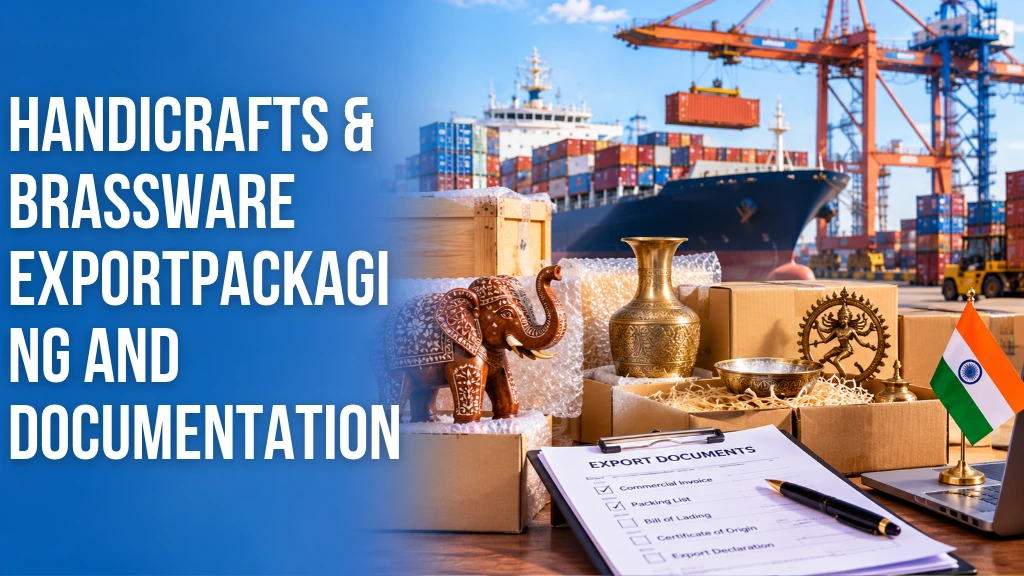
Shipping handicrafts and brassware internationally involves more than preparing an export invoice and booking cargo space. Fragile finishes, irregular shapes, moisture exposure and inadequate cushioning can turn a carefully manufactured product into a damaged delivery. For exporters in Moradabad and other Indian manufacturing hubs, packaging, documentation and transport planning need to work together from the factory to the overseas buyer.
A successful handicraft export from India starts with understanding the product’s physical risks, selecting suitable packaging, preparing accurate export documents and choosing a freight arrangement that fits the shipment’s size, value and destination. The right approach depends on whether you’re shipping delicate decorative pieces, brassware, wooden handicrafts or mixed consignments.
Key Takeaways:
- Match packaging to the material, shape, finish and fragility of each item.
- Protect brassware against scratches, moisture and surface tarnishing.
- Check export documents and destination-specific requirements before dispatch.
- Compare air, sea, LCL and FCL options using total logistics costs.
- Verify wooden packaging requirements before shipping internationally.
Why Handicraft Shipping Requires Specialised Planning
Handicrafts often combine materials, finishes and shapes that respond differently to handling and environmental conditions. A brass ornament may develop surface marks through contact with other metal pieces, while a carved wooden item may be vulnerable to impact, moisture or abrasion. Delicate decorative pieces may also have protruding components that can break if pressure is applied during stacking.
These risks become more difficult to manage when cargo passes through several handling points, including factory collection, warehouse consolidation, export terminals, international transit and destination delivery.
For exporters, handicraft shipping from India should therefore begin with a product-level assessment rather than a standard packaging method for the entire consignment.
Consider a shipment containing brass bowls, carved wooden decorations and delicate wall hangings. Each product may require different inner protection, separation and outer packaging, even if all three are being sent to the same buyer.
The objective is to reduce the risk of movement, abrasion, crushing and environmental exposure without adding unnecessary weight or dimensions that increase freight costs.
What Makes Handicrafts and Brassware Vulnerable?
Before arranging freight, identify the characteristics that influence how each item should be packed.
- Fragility: Thin, delicate or projecting components can break under impact or pressure.
- Surface sensitivity: Polished brass, painted finishes and decorative coatings may be scratched by friction.
- Irregular dimensions: Unusual shapes can leave empty spaces inside cartons and crates.
- Material differences: Wood, metal, glass and fabric respond differently to moisture and handling.
- High perceived or commercial value: Damage can lead to rejected deliveries, replacement costs and disputes with buyers.
These are practical packaging considerations rather than a universal regulatory classification. The appropriate protection should be determined by the actual product and the conditions it is expected to encounter.

How to Pack Handicrafts for International Shipping
Effective handicraft packaging for export uses several layers of protection, each serving a specific purpose. The exact materials and design depend on the item’s weight, shape, surface finish and fragility.
1. Protect the Surface First
Clean, dry items should be protected from direct contact with abrasive packaging materials and neighbouring products. Suitable non-abrasive wrapping can help prevent scratches, while individual sleeves or separators reduce friction between pieces.
For polished brassware, avoid packing finished surfaces directly against other metal objects. Where a product has a delicate coating, confirm that the wrapping material is compatible with that finish before packing the full order.
2. Add Cushioning Around the Item
Inner cushioning helps absorb shocks and limits movement inside the package. The packaging should support the product at appropriate points rather than applying pressure to thin edges, handles or decorative projections.
For irregularly shaped handicrafts, a fitted insert or carefully arranged cushioning may offer better support than loose material that shifts during transit.
A useful pre-dispatch check is to confirm that the item cannot move freely inside its packaging and that the outer carton does not press directly against fragile components.
3. Choose the Right Outer Carton or Crate
The outer package must withstand the expected handling and stacking conditions. Strong cartons may suit lighter items, while heavier or unusually shaped products may require a more robust packaging design.
Consider the following before selecting the outer packaging:
- The packed weight and dimensions
- The product’s resistance to compression
- The number of items in each package
- Expected stacking and handling conditions
- Whether the cargo will move as consolidated freight or a dedicated shipment
Do not select packaging solely on appearance or material cost. A package that is too weak can expose the goods to damage, while unnecessarily large packaging can increase the chargeable volume of the shipment.
4. Control Moisture Exposure
Moisture management matters for both metal and wooden handicrafts. Condensation, damp packaging or exposure to humid conditions can affect certain finishes and materials during storage and transit.
Keep products dry before packing, use packaging appropriate to the material and consider whether the expected route or storage environment creates additional moisture risks.
For brassware, protective wrapping and separation can help reduce surface contact and exposure. However, the suitable method depends on the finish and the manufacturer’s handling guidance; no single wrapping material is appropriate for every brass product.
5. Secure the Package for Handling
The outer package should remain stable during lifting, movement and loading. Internal voids should be managed so that items do not shift, and the package should be closed and secured in a way that suits its weight and construction.
Clear package identification also helps warehouse and freight teams distinguish consignments and match packages against shipping records.
Before dispatch: Inspect a sample of packed items, check the packaging against the product’s specific risks and confirm that package counts and dimensions match the shipping documents.
Brassware Export from India: Preventing Scratches and Tarnishing
Brassware export from India requires particular attention to surface protection because decorative brass products may have polished, lacquered, plated or otherwise treated finishes. Packaging that works for an unfinished metal item may not be suitable for a coated decorative piece.
For example, placing several polished brass bowls together without individual separation can allow movement during transit. Even if none of the bowls breaks, rubbing between surfaces may leave marks that affect the buyer’s acceptance of the shipment.
A practical brassware packaging checklist should cover:
- Individual protection: Separate finished pieces to minimise surface-to-surface contact.
- Finish compatibility: Check that wrapping does not react with or damage the product’s finish.
- Moisture management: Keep products and packaging dry before closing cartons.
- Movement control: Prevent items from shifting inside the carton.
- Edge and projection protection: Give handles, decorative edges and raised details appropriate support.
- Inspection: Check representative packed products before the consignment is sealed.
Where brassware is mixed with wood, glass or other materials, use packaging suited to each material instead of treating the shipment as one uniform product category.
For exporters in Moradabad, where brassware and decorative metal products form part of the manufacturing landscape, this product-specific approach can help make packing decisions more consistent across repeated orders.
Handicraft Export Documentation: What Should You Prepare?
The handicraft export documentation required for a shipment depends on the goods, transaction, export route and destination-country rules. India’s Directorate General of Foreign Trade (DGFT) identifies three core documents for exports: a transport document, a commercial invoice-cum-packing list and a Shipping Bill, Bill of Export or Postal Bill of Export, as applicable. Additional documents may be required for restricted goods or product-specific regulatory conditions.
Exporters handling different product categories can also review these export documentation requirements and compliance essentials to understand the documentation considerations that may apply to their shipments. For a typical commercial shipment, prepare the following documents and verify which requirements apply to the particular consignment.
1. Commercial Invoice
The commercial invoice records the transaction between the exporter and overseas buyer. It should accurately identify the products, quantities, values and relevant parties.
Descriptions should be specific enough to distinguish the products being exported. For example, a detailed description of a brass decorative bowl is more useful for shipment review than a generic description such as “handicraft items.”
Ensure the invoice aligns with the purchase order and the packing list.
2. Packing List
The packing list shows how the goods are arranged for shipment. It commonly records package counts, product quantities, weights and dimensions.
This information is important for booking cargo space, planning handling and checking that the physical consignment matches the shipping paperwork.
Where products have different packaging arrangements, identify the packages clearly rather than combining unlike items under an ambiguous description.
3. Shipping Bill
The Shipping Bill is the relevant customs declaration for goods exported from India by sea or air, subject to the applicable procedure. Section 50 of the Customs Act, 1962 addresses the entry of goods for exportation through a Shipping Bill or, for land exports, a Bill of Export.
The exporter or authorised representative should ensure the declaration matches the commercial documents and applicable customs requirements.
4. Transport Document
The transport document depends on the chosen mode. Air shipments generally use an Airway Bill, while sea shipments use the relevant ocean transport document, such as a Bill of Lading.
The details should align with the consignment’s routing, parties and cargo description.
Additional Certificates or Approvals
Some products may be subject to additional requirements based on their material, composition, intended use or destination. Do not assume that every handicraft needs the same certificate—or that no additional documentation is required because the goods are decorative.
Before dispatch, verify whether the specific product is restricted, subject to an export policy condition or covered by a destination-specific import requirement. Product-specific claims should be checked against the relevant official authority rather than inferred from the broad label “handicraft.”
Air or Sea Freight: Which Suits Your Handicraft Shipment?
The right transport mode depends on the shipment’s urgency, packed volume, weight, value, destination and handling needs. Neither air nor sea freight is automatically the right choice for every handicraft exporter.
| Factor | Air freight | Sea freight |
| Delivery priorities | Often suitable for urgent consignments | Often suitable when longer transit is acceptable |
| Cargo profile | Can suit smaller or time-sensitive shipments | Can suit larger or heavier consignments |
| Cost considerations | Compare chargeable weight and handling costs | Compare freight, origin and destination charges |
| Planning needs | Check flight schedules, acceptance and cut-off times | Check vessel schedules, port handling and delivery arrangements |
Air freight may suit a small, high-value order needed for a trade event or retail launch. Sea freight may be more practical for larger shipments of brassware or decorative products when the buyer can accommodate the longer journey.
In either case, compare the full logistics cost and expected delivery timeline—not just the headline freight quote. For a more complete view of shipment expenses, use this guide to calculate the total landed cost of a shipment and identify costs beyond the quoted freight rate.
When Should You Consider LCL or FCL?
Less than Container Load (LCL) allows cargo to share container space with other shipments. Full Container Load (FCL) refers to a shipment arranged as a full container movement.
For a smaller handicraft order, Air & Sea Cargo Consolidation may provide an option for sharing cargo space instead of booking an entire container. However, consolidated freight involves additional handling and coordination, which should be considered when packing fragile or surface-sensitive goods.
FCL may offer greater control over how a shipment is loaded and secured, depending on the arrangement, but it is not automatically cheaper or safer. The right choice depends on cargo volume, route, handling requirements and the total charges involved.
For a more detailed comparison of container arrangements, compare LCL and FCL shipping options based on shipment size, handling needs and total cost.
Wooden Crates and ISPM-15 Requirements
Wooden crates, pallets and dunnage can provide structural support for heavier or irregularly shaped handicrafts. However, when solid wood packaging is used for international trade, phytosanitary requirements may apply.
The International Plant Protection Convention (IPPC) standard ISPM 15 addresses the regulation of wood packaging material in international trade to reduce the risk of spreading quarantine pests. It covers relevant raw-wood packaging material, including dunnage, while excluding wood processed in ways that make it pest-free, such as qualifying plywood.
Before using wooden packaging, check the importing country’s requirements and confirm whether the proposed material falls within ISPM 15’s scope. Where the standard applies, ensure the packaging has received the required treatment and bears the appropriate mark through an authorised process.
Do not assume that every wooden product is regulated in the same way. The requirements for a wooden handicraft being exported as merchandise can differ from those applicable to solid-wood packaging used to carry that merchandise.
Customs, Insurance and Delivery Planning
Packaging and documentation need to match the planned logistics arrangement. A consignment can be packed correctly yet still encounter problems if its declared dimensions are inaccurate, its documents contain inconsistent descriptions or the destination requires additional information.
To understand the stages that follow document preparation, read this guide to how a shipment moves through the customs clearance process.
Before booking, confirm the cargo description, package count, weights, dimensions and transport mode. Check whether the shipment needs special handling and whether the destination buyer has instructions for delivery, unloading or receipt.
Cargo insurance should also be considered in light of the goods’ value, route, handling and applicable policy terms. Do not assume that carrier liability provides the same protection as an appropriate cargo insurance policy. Review the scope of cover, exclusions, valuation basis and claims documentation before shipment.
For exporters, handicraft export logistics works best when packing, customs documentation, freight booking and final delivery are planned as one connected process. Customs Brokerage service can support customs-related documentation and compliance coordination.
Choosing a Freight Forwarder for Handicraft Exports
A freight forwarder should understand the shipment’s physical characteristics as well as its transport requirements. The lowest quoted rate may not represent the lowest overall cost if packaging, handling, consolidation or destination charges have been overlooked.
When comparing providers, ask:
- Can the provider explain the available air and sea options for this cargo?
- Are the proposed package dimensions and weights reflected in the freight quote?
- Who coordinates export documentation and customs declarations?
- What handling arrangements are available for fragile or irregularly shaped items?
- Are origin, destination, consolidation and delivery charges clearly identified?
- Which party should be contacted if the shipment is delayed or arrives damaged?
These questions help you evaluate the complete service rather than relying on broad claims about speed or savings.
A Pre-Dispatch Checklist for Handicraft Exporters
Use this checklist before releasing a shipment to the freight provider.
- Confirm that each item has suitable surface protection and cushioning.
- Check that cartons or crates can withstand the expected handling conditions.
- Verify that the packaging protects delicate edges, projections and finishes.
- Confirm the final package count, dimensions and weights.
- Match the commercial invoice and packing list against the actual cargo.
- Check the Shipping Bill process and any additional product-specific requirements.
- Verify applicable destination rules for wooden packaging.
- Compare air, LCL and FCL options against the shipment’s delivery needs.
- Review insurance terms and retain relevant shipment records.
- Confirm delivery arrangements and responsibilities with the overseas buyer.
A documented pre-dispatch check gives the exporter, freight forwarder and consignee a consistent reference if a question arises during transport or receipt.
Coordinating Handicraft Export Logistics from India
Successful handicraft freight forwarding depends on connecting product preparation with transport, customs and delivery planning. Exporters in Moradabad and other manufacturing centres may need to move cargo through suitable air or sea gateways, depending on the destination and the available services.
Mumbai and Mundra may be relevant options for some sea-freight movements, while Delhi can be relevant to certain inland collection and air-cargo arrangements. The appropriate gateway depends on the shipment’s origin, destination, schedule and routing; no single route is mandatory for every exporter.
For fragile cargo shipping in India, clear coordination is particularly important when the consignment contains different materials or products that require separate packaging arrangements. The exporter should share accurate cargo details early so the freight plan reflects the shipment’s actual size, weight and handling needs.
Conclusion
A successful handicraft export from India requires attention to the details that protect the product and keep the shipment organised. Suitable packaging reduces exposure to impact, friction and moisture, while accurate documentation helps align the cargo with customs and transport requirements.
For brassware, surface protection and separation are particularly important. For wooden crates and pallets, verify whether ISPM 15 and the destination country’s requirements apply. For freight selection, compare air, LCL and FCL options using the complete logistics cost, delivery timeline and handling requirements.
By checking packaging, documents and transport arrangements before dispatch, you can identify avoidable problems while there is still time to address them.
Planning an international handicraft shipment? Contact ClearFast Group to discuss the cargo profile, destination and available freight options, and determine what documentation and handling arrangements need to be confirmed before dispatch.
Frequently Asked Questions
1. How do you export handicrafts from India?
To export handicrafts from India, prepare suitable product packaging, verify the applicable export requirements, arrange the commercial invoice and packing list, and complete the relevant customs declaration and transport documentation. Confirm destination-specific requirements before dispatch, as additional certificates or approvals may apply to particular materials or products.
2. How should brassware be packed for international shipping?
Brassware should be protected against scratches, surface contact, movement and moisture exposure. Wrap individual pieces using materials compatible with their finish, cushion delicate edges and secure items inside suitable cartons or crates. The exact packaging method depends on the product’s weight, shape, coating and expected transport conditions.
3. Which documents are required for handicraft exports from India?
Core export documents generally include a transport document, commercial invoice-cum-packing list and Shipping Bill or applicable export declaration. Additional documents may be required depending on the goods, export policy conditions and destination rules. Verify the current requirements for the specific product before submitting the customs declaration.
4. Is ISPM 15 required for all handicraft packaging?
No. ISPM 15 applies to specified wood packaging material used in international trade, including relevant raw-wood pallets, crates and dunnage. It does not apply universally to every packaging material or wooden handicraft. Check the standard’s scope and the importing country’s current requirements before selecting wooden packaging.
5. Is air freight or sea freight better for shipping handicrafts internationally?
Air freight may suit urgent, smaller or high-value handicraft consignments, while sea freight can be suitable for larger shipments when longer transit times are acceptable. Compare total freight costs, handling requirements, packaging dimensions and destination charges before choosing. The right option depends on your cargo, budget and delivery deadline.